Redundancy the Hobgoblin

164491_483395175055094_837043352_n

Is a tiny little bit the same as a little bit?

My computer’s grammar editor thinks so. But I don’t.

If my viewpoint character is a little girl, there absolutely must be a difference between a “tiny little bit” and a “little bit.”

She’s little. She sees small differences much better than an adult. Her eyes are better up close. She hasn’t been to school and learned to avoid redundancies. She talks like a child and would write like one if she were old enough to write.

Here she is…

“I only took a tiny little bit of it, Sir. I’m sorry, I won’t ever do it again. Never ever, ever in a million-zillion years.”

That was dialogue not narrative, you’re thinking. OK, good point.

Here she is again as viewpoint character, “writing” her story…

She thinks that just because I’m six I’m a dummy. But she’s the dummy. If you don’t eat you die. I saw people die from no food. She didn’t. The Mesa’s gone. She’s the dummy. Anyways, I just took a tiny little bit.

That would be an over use of the word “dummy” in polite circumstances, but not here. To me, the feeling of this little girl’s presence (the voice) is better served by the “dummy” redundancy than it would be by synonyms. Say, for instance, one dummy, one ignoramus and a stupid-head. This trio wouldn’t carry the girl’s essence.

And if she had said that she took a “little bit,” it would seem dangerously more than the “tiny little bit” she said she took.

According to Ralph Waldo Emerson, “A foolish consistency is the hobgoblin of little minds.” So it should come as no surprise that I consistently delete redundancies to tighten my prose. It’s a brainless habit.

Instead, I should learn to view redundancy as a legitimate and valuable tool for conveying the viewpoint character’s personality.

Not only can there be a big difference between something that’s “little” and something that’s “tiny little,” there can also be an important difference between something that’s “little” and something that’s “little, little.”

The difference is about the narrative personality of the viewpoint character – the “author’s” voice – not about the logical meanings, or the pedantic mechanics of the words.

M. Talmage Moorehead

To download of my new aging e-book, Writing Meaningful Page-Turners, click here. It talks about why we are more than storytellers, and how lucky we are to be inside the most influential group on Earth. The last chapter tells how I met a viewpoint character who added a dimension of meaning to my life. Writing went from work to fun. It could happen to you.

To read my in-progress novel, Hapa Girl DNA from page 1, it’s here as a scrolling document.


Butchering the Stars

307472_487227851338493_2049100976_n

Here are a few paragraphs of a best seller.

The Fault In Our Stars

by John Green

…Depression is a side effect of dying. (Cancer is also a side effect of dying. Almost everything is, really.) But my mom believed I required treatment, so she took me to see my Regular Doctor Jim, who agreed that I was veritably swimming in a paralyzing and totally clinical depression, and that therefore my meds should be adjusted and also I should attend a weekly Support Group.

This Support Group featured a rotating cast of characters in various states of tumor-driven unwellness. Why did the cast rotate? A side effect of dying.

The Support Group, of course, was depressing as hell. It met every Wednesday in the basement of a stone-walled Episcopal church shaped like a cross. We all sat in a circle right in the middle of the cross, where the two boards would have met, where the heart of Jesus would have been.

I noticed this because Patrick, the Support Group Leader and only person over eighteen in the room, talked about the heart of Jesus every freaking meeting, all about how we, as young cancer survivors, were sitting right in Christ’s very sacred heart and whatever.

So here’s how it went in God’s heart: The six or seven or ten of us walked/wheeled in, grazed at a decrepit selection of cookies and lemonade, sat down in the Circle of Trust, and listened to Patrick recount for the thousandth time his depressingly miserable life story—how he had cancer in his balls and they thought he was going to die but he didn’t die and now here he is, a full-grown adult in a church basement in the 137th nicest city in America, divorced, addicted to video games, mostly friendless, eking out a meager living by exploiting his cancertastic past, slowly working his way toward a master’s degree that will not improve his career prospects, waiting, as we all do, for the sword of Damocles to give him the relief that he escaped lo those many years ago when cancer took both of his nuts but spared what only the most generous soul would call his life.

Here’s a link to John Green’s web sitehttp://johngreenbooks.com/

The reason I posted this is because it grips me and pulls me in but lacks a certain polished sound that I sometimes foolishly try to create. The way Green’s story is written excites me, partly because I’m not a gifted poet or a writer with naturally beautiful language.

I’m not saying I could write something this good. The content of this story would be at least impossible for me to match. And also it would be difficult for me to write anything this raw-sounding because I’ve been brainwashed into over-editing my work until it sounds sterile.

For instance, here is what I would lamely do with one of John Green’s fantastic paragraphs. (Forgive me Mr. Green, your way is infinitely better than what I’m about to do.)

[Like cancer, d]Depression is a side effect of dying. (Cancer is also a side effect of dying. [In a way, a]Almost everything is, really.) But m[M]y mom believed I required [needed] treatment, so she took me to see my R[r]egular D[d]octor[,]Jim, who agreed that I was veritably swimming in a paralyzing and totally clinical major depression, and that therefore [needed adjustment of] my meds should be adjusted[,] and also I should attend a weekly S[s]upport G[g]roup.

Just for clarity’s sake, here again is Green’s outstanding paragraph as it was before I butchered it (by following the rules and advice I’ve learned in school and from “how-to” books on writing fiction).

Quoting John Green again…

Depression is a side effect of dying. (Cancer is also a side effect of dying. Almost everything is, really.) But my mom believed I required treatment, so she took me to see my Regular Doctor Jim, who agreed that I was veritably swimming in a paralyzing and totally clinical depression, and that therefore my meds should be adjusted and also I should attend a weekly Support Group.”

I ask forgiveness again for the butcher job above, but I hope it was useful to other writers. It certainly was an eye-opener to me – with all my devilish word-editing habits that crush the “voice” of the viewpoint character and bleed the excitement out of my fiction, at times.

I guess the worst thing I did (above) to Green’s paragraph was to obscure the sense that it was written, literally written, by a young person who was more concerned with cancer and dying than with writing schoolish prose.

You might try this: Copy an important paragraph from a best-seller and pretend it’s something you wrote long ago. Edit “yourself.” Study the damage you’ve done, if any.

Then, if you’re like me, you’ll feel sheepish and realize that you’ve learned something from a successful professional with a writing career in the real world.

M. Talmage Moorehead


basketball and writing a page-turner

Squirrel Finnegan the wannabe dog pupThe process of improving my fiction writing continues to parallel the process I devised for learning to shoot a basketball.

There are an infinite number of variables in each sport. It seems that the more of those variables I control or eliminate, the faster I improve.

In learning to shoot a basketball, it was easy to eliminate the unessential movements.  Give the shot a little random head tilting and an inconsistent jump and you might as well move the hoop during the shot. So forget practicing like everybody else does.

I stood close to the hoop, didn’t change position, didn’t jump, bend my knees, or worry about what was going on in my mind. I kept my shoulders and head steady during every shot.

Then I shot a hundred times per day for quite a while. This isolated my arms, hands and fingers – the minimal number of uncontrolled variables essential to sinking a shot.

After a while I could get the ball through the hoop every time from that one spot. Then I brought a jump into the deal. Then a little more distance, and a little more.

Did it help?

Yeah, like magic. I went from pathetic to annoying. There were a few games where everything I shot went through the hoop. If I’d been decent on defense, I could have made the D league for the vertically challenged.

No brag, just fact.

With fiction writing I’m taking the same approach – eliminating variables to isolate the essentials.

The main thing I want to create is a novel that’s difficult to stop reading. You might call it a page-turner, I guess. I want it to be meaningful. It would also be nice if literary critics around the world would send flowers to my wife.

To identify the essentials, I’m studying the work of best-selling fiction authors. These people are doing something right. I want to discover what it is, so I can practice like a fiend.

Of course, I intend to continue posting all my epiphanies here.

Each highly successful popular author I’ve studied seems to have a set of talents that is slightly different from the next. Some are not so gifted with words, but have interesting ideas and characters. Some are able to write like poets and yet weave complex plots involving a large cast of characters. Others write simple plots with few characters, simple words and breathtaking dialogue. Some don’t seem to stand out in any way, except that I can’t put their books down.

The combinations of the different underlying writing talents are probably infinite.

In basketball, a person must have rare talent in almost every aspect of the game if he’s going to have a chance to play professionally.

In writing fiction, it doesn’t seem like that at all. Yes, there’s a common thread connecting best-selling authors, but it’s thin and subtle, not thick and obvious, as in basketball.

When you find what your main talent is as a writer, you’ll be able to isolate it and work on it. If you keep at it, you’ll probably be able to write a page-turner. Once you’ve done that, you’ll have a fairly decent chance of becoming a professional.

There are a few people out there with great advice on selling your novel, but if your novel isn’t difficult to put down, you could be wasting your time.

Maybe I don’t want you to do that.

Identify your strongest writing talent. Isolate it from the noise. Build its muscles. Write things that depend on that talent.

This approach will produce the sort of page-turner you’re capable of writing. It will be unique to you.

Of course, not all writers want to write page-turners. Not everybody wants to reach millions of people.

That’s understandable.

In the final analysis, all fiction writers succeed – because it’s this journey we’re on that matters, not so much the destination.

M. Talmage Moorehead


Fear and Your Writing Voice

IMG_2217Have you ever sat down with someone younger than you and told them the complex details of something you knew backwards and forwards?

If so, this feeling, this confidence is the cornerstone of your writing voice for fiction.

Talking to this younger, less experienced person, you probably weren’t afraid of getting the details wrong. You weren’t afraid of criticism from a higher realm of expertise. You weren’t self-conscious about your choice of words. You probably had enthusiasm because the topic was important and might have helped the younger person.

In earlier versions of my story, I had my main characters, Johanna and Maxwell, in a hospital setting that made me feel timid. The bottomless pit of details in clinical medicine has always worried me sick.

In the back of my mind I’m worried about how people from work might react if one of my characters says something negative… about a surgeon or a drug, for instance.

This mindset is a straight-jacket.

What if Maxwell wanted to say, “All surgeons are brain-dead.” I couldn’t let him. It would be too politically dangerous for me.

In that earlier version, I felt unsure about the wording of every sentence because I wanted the viewpoint character, a doctor, to sound highly intelligent but not boring.

In that same version of the story there was also a viewpoint characters living in a science fiction type world. When writing his part I felt fearless and authoritative. After all, who could be offended or say I botched an important technical detail in a simple sf world?

A professional author was reading this version of the story and saw glaring problems with the chapters involving the hospital with the MD viewpoint character.

But in the science fiction setting where the viewpoint character was not particularly intelligent, things got better. The author helping me wrote the following in the margin: “For what it’s worth, [your] sentence-level writing seems more assured/less awkward as chapters progress.”

Hey, he didn’t say I was going to set the world on fire, but at least he saw improvement.

It took me awhile to figure out what was going on, but I figured it out.

I need to do anything I can possibly do to be the only expert in the room when I’m writing fiction.

I need to stay out of hospital settings and other settings that make me feel self-conscious and afraid.

I need to be anonymous and use a pen name so the people at work, my friends and family, can’t frighten me out of saying what’s on my mind and in my heart.

I need to pretend that I’m writing to a nice, inexperienced younger person who wants to hear what I have to say and who, by some miracle, knows less about it than I do.

A “strong writing voice,” if you can tolerate the concept, is based on confidence. I suspect it is confidence and nothing more.

M. Talmage Moorehead


Ending a Novel Before Tea

7-20-09 Capilano Suspension Bridge and Stanley Park 017When there’s a cup of tea sitting on my desk, something happens to me. It’s probably my subconscious mind seeing what it really wants – caffeine. Even though I haven’t taken a sip yet, I wake up a little. I feel marginally great about life, just knowing it’s there.

These are valuable moments when natural neurotransmitters and hobgoblins wake up creativity. Later, when you drink the stuff, the caffeine causes vascular constriction which takes creativity down a tad, still above baseline though, for me.

I was in tea-anticipation mode for ten minutes just now and finally, after months of whining, found a decent way to move my hero and villain away from their current friendly relationship towards a closing conflict.

It had to be a natural road from here to there. The outline was flexible, so I didn’t feel hemmed in. All I needed was an idea.

In the outline stage, I knew a lot about my villain, but I hadn’t seen her in action. I hadn’t asked her any questions.

It turned out she was nothing like the outline pictured.

Fortunately, the key was the tea. (And not drinking it.)

After seeing her in action, I knew the answers to some key questions:

Why does she hate her mother and feel guilty about it?

What is the worst thing that she’s ever done? How does she feel about it now vs then?

Is she a good person in her own opinion?

Does she have true human values?

Where are the blind spots in her sense of right and wrong?

What scares her the most, and how does she react to it?

After seeing her answers in the first draft, I was stuck. This was the burning question:

What could my hero do to make my 3-D villain frightened enough or angry enough to destroy her?

After months of working on other parts of the story, letting this question simmer, the answer came to me. It came while I was day-dreaming about the characters, away from the desk, doing something else, not even trying to think of an ending.

The tea was, of course, waiting. Tea anticipation causes the lion’s share of creative breakthroughs.

You think I’m kidding.

M. Talmage Moorehead


How Johanna Turned Me Into a Writer

1 shot from 80 yards! YT

Love is where writing began for me.

I couldn’t hack it when I started writing fiction. I would drudge up a few tedious pages, look them over and feel hollow and exhausted.

I wondered how anyone could muster up enough self-discipline to write fiction.

Yet earlier in college where everyone swam in hard work – and even before college where I seemed to be the only one studying all the stinking time – I deeply enjoyed the few fiction writing opportunities that came.

What had changed after college? I still felt deep down that I was a born writer.

Then one day in my first year of med school, with no plan or purpose, I found myself creating two people who were SCUBA diving off the backside of Molokai, Hawaii. They were ocean-going archaeologists. The viewpoint character was a young man, the other person was a Japanese girl, Johanna, who reminded me of my wife.

I saw Johanna for the first time in 39 feet of water uncovering part of a petrified skeleton, using only her hands. She must have been excited. The viewpoint guy did a double-take because her hands were moving as fast as a machine.

As a writer, something weird and amazing began happening for the first time: a character of mine was showing signs of life.

Intuitively, I knew a lot about Johanna at first glance because somehow she was just like my wife.

So I was literally in love with Johanna before we met.

As she and the viewpoint guy with her (Max) approached the dive boat, she swam up next to him and told him to cover his head.

Then, before he knew it, he was flying through the air and landing on deck.

Johanna, who was suddenly with him in the boat, began stammering through apologies, explaining that a shark had come too close and she’d overreacted and shoved him up into the boat with too much force.

“But how?” Max (and I) wondered.

Maxwell couldn’t stop questioning her and asking about her impossibly fast hands.

Finally she told him an ancient family secret of the Fujiwara clan: there was a recessive trait that had remained dormant for centuries and had never been expressed in a female. Johanna had inherited it with this unprecedented phenotypic penetrance.

It was easy to tell that, in her way of thinking, it was shameful and embarrassing for a girl to be as strong and quick as she was. To her it was boyish and therefore a repulsive quality in a girl. She swore Max to secrecy.

And I fell in love. (With my wife, OK? She and Johanna were the same person at heart.)

From that day to this, writing fiction has been fun and meaningful. At times it feels almost like an addiction. It never seems like work – but I’m not a professional writer yet, so how could it?

One thing: it’s not just an addiction. Writing fiction feels like a higher purpose – sort of a “calling.”

And when new ideas come, creating a place for them in the latest rewrite of Johanna’s story is a powerful force of joy.

Decades after meeting her, I’m still writing about Johanna. The stories change. She’s grown younger as I’ve grown older. She still rivets me to this keyboard.

If I ever get paid for writing about her, it won’t seem right. I’ve always had to work at an isolating and difficult job for money (update: I was a pathologist, but recently quit). It will seem weird if I ever get paid for writing about Johanna.

Not that I think money is a negative thing. I don’t at all.

“May the Lord smite me with it. And may I never recover!”  (-Fiddler on the Roof)

But since meeting Johanna, the writing process itself is the only payoff I really need. I’m pretty sure that I need to write fiction in order to be happy.

The hope of finding readers comes and goes. It’s not essential that I find them, but the process of trying can be great fun! All the blogging and exchanging comments with brilliant, fascinating people – it’s a blast! I wish we were all face-to-face friends.

Someday, huh?

But the practical point I want to make about Johanna is the milieu in which I met her: an unstructured environment where the main character was free to act intelligently, free to become, free to decide, and free to experience the natural consequences of her own choices.

The best-selling stories that I admire most are written at the other extreme – around organized plots with detailed planning and outlines.

For me, plotting is the hardest part of fiction writing, and the most neglected. I’m told that it’s neglected even in University creative writing classes, probably because it requires huge mental effort and has a cause-and-effect association with capitalism: book sales.

I think most any average reader (like me) recognizes the value of plot.

I want readers, so I work at my plots.

Outlines seem to help, although Johanna won’t stick to any of mine for long.

Yes, I know that’s nuts. Talk to her about it. 😉

I’m working to nudge Johanna’s life in the direction of a designed, semi-predetermined plot, so she winds up in a “meaningful page-turner” with an active storyline, a few round characters and a dimension that might cause a reader to take a new look at some of our culture’s lamest assumptions.

As a writer, I welcome a compelling plot as long as it bends and steps aside for characterization and new ideas that arrive.

But the reality is – and this is the point of telling you all this – I never would have become a fiction writer if I hadn’t met Johanna in a place that was free of plot and determinism.

My life would never have been enriched by my kind-hearted, strong-willed, genius girl, Johanna, if I’d started as a puppeteer rather than a humble creator with respect and growing love for a “real” person with free will.

Love is where writing began for me.

M. Talmage Moorehead

Please opt into my mailing list so I can let you know when my books are ready: Click Here 🙂

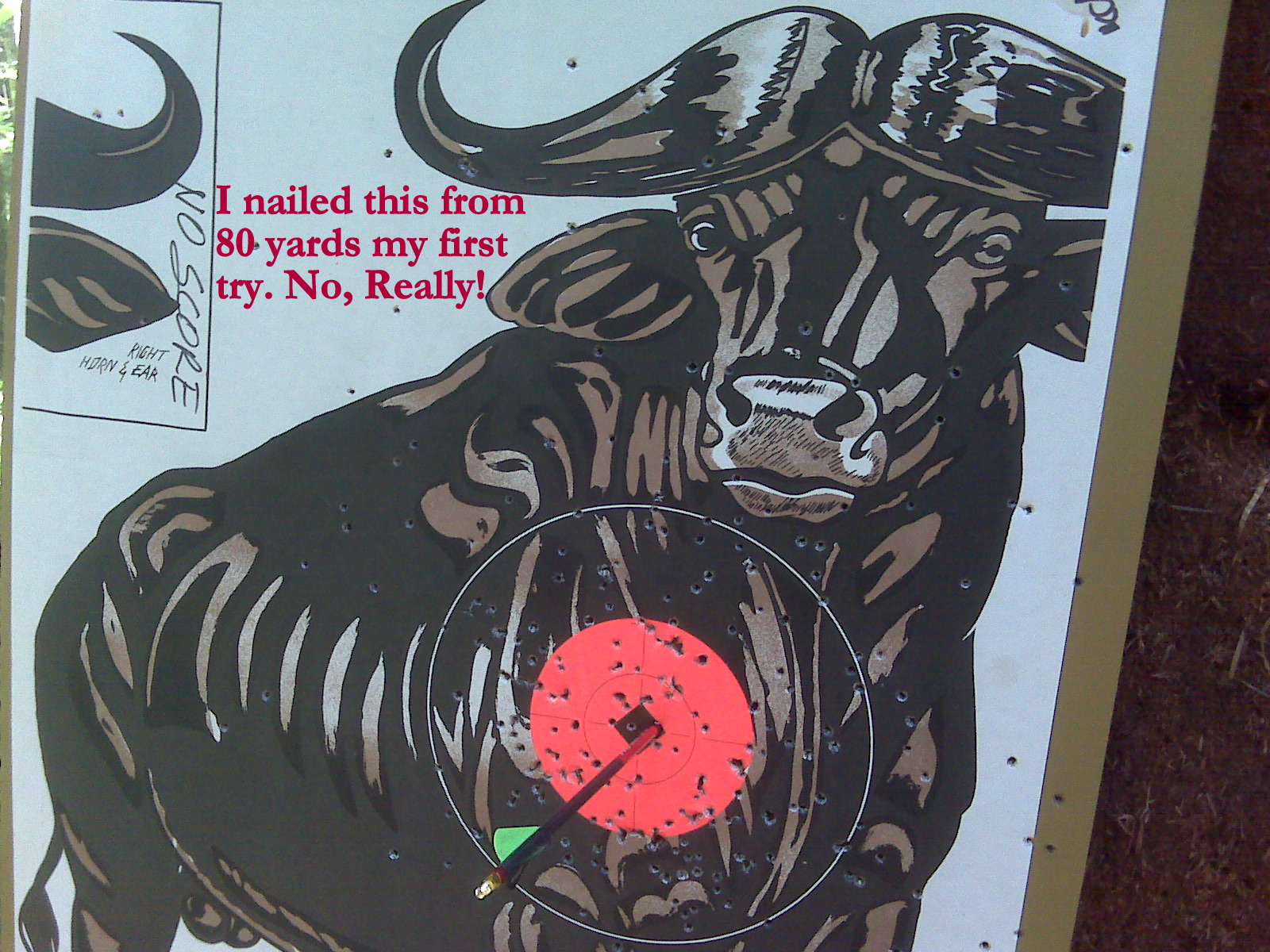
By the way, regarding the picture up top with the arrow inside the squarish bull’s-eye…

With God as my witness, I hit that shot on my first try from 80 yards with my new bow. I’m a novice with bows and arrows. I don’t have a fancy scope like the pros use. I wouldn’t know how to use it if I did. The basic scope that I had wasn’t sighted in at 80 yards. I’m quite sure that I could never hit that shot again in a hundred years – speaking from logic and objectivity, not pessimism.

But the first time I tried it, I nailed it from eighty yards.

What does this mean, if anything?

I keep wondering if there was more than coincidence at work. “But what?” someone might ask. “There’s nothing besides coincidence to explain it.”

Nevertheless, eighty yards is one heck of a long shot for a novice with a new bow without a target-shooting type scope. At the archery range where this happened, only two 80-yard shots are available.

A person only shoots his or her first 80-yard shot at a given target once in a lifetime.

Incidentally, I would not recommend using such an unlikely plot point in a story. It might not be normal enough for fiction. But in real life, stranger-than-fiction things happen…

For instance, Einstein’s time dilation is real and measurable. And the notion that most of the stuff of the Universe is either “dark matter” or “dark energy” is real to the right batch of scientists.

Anyway, this bull’s-eye shot seems as likely as a brand-new writer meeting someone as amazing as Johanna Fujiwara.

When these sorts of things happen, do you think maybe God is trying to tell someone something? Sorry, I didn’t mean to get religious on you. I’m not a fundamentalist Christian anymore, but I’ll always respect those who are.


This is Really Boring. Don’t read it.

Do you feel sick every morning? Not to worry.

Aside from the brutish and manly fulfillment that fiction writing brings me, especially the current version of my novel with a nineteen-year-old girl as viewpoint protagonist, there are several things that help me get top-notch hack writing done.

Insomniacs take note…

1. My most thrilling and important writing prep is – wait for it – getting an excellent week’s sleep. One night won’t cut it – except that it be preceded by six.

A good night’s sleep is 8.5 to 9.5 hours without a dozen wake-up calls from 7-30-09 Mt Bachelor and Museum 019the neighborhood deer barking at dogs.

Most of my life I’ve been sleep-deprived and too stupid to know.

Before deserting the workforce to cruse half-time and have a life, I went to bed at 11:15 to 11:30 PM and got up at 7:10 AM. That sounds like almost eight hours of sleep, but it’s not. Not to me, anyway.

I take a long time going to sleep, same as a lot of brutish creative types with chiseled features.

I remember how foggy my mind was in those days. It didn’t seem quite normal, but it did seem unavoidable.

It’s true that “you don’t know what you’ve got ’till it’s gone.” Even the bad things like sleep deprivation.

Here’s what’s also gone now: feeling physically ill every morning. (Aching bones and muscles, the realization that it’s a hundred miles from my bed to my tooth brush, and the nagging question of what day it actually is.)

I thought anything resembling 7.5 to 8 hours was adequate sleep. People “get by” on five or six all the time. It’s easy to get sucked into the madness.

The truth is, our culture promotes sleep deprivation as a healthy norm. And different people have different sleep requirements, a fact that raises confusion.

Nowadays, with 8.5 to 9.5 hours of actual sleep, it feels as if something is going horribly right in my life.

Furthermore, in fulfillment of Koch’s postulates, if I get only 7 hours, I wake up half dead. Just like old times!

Like most brilliant writers, you have trouble falling asleep.

Huh? Yeah, you do.

To exterminate insomnia, I use biofeedback. Before you roll your eyes, consider my newest feedback image and the fact that you don’t need any machines or gadgets to do this:

I picture bees landing on my hands, a few at a time, until they’re so crowded the bees look like mittens. I try to “feel” their feet touching my skin, hear their wings and picture their yellow-and-black bellies. The rule is, they’ll sting me if my mind wanders off to ruminate with the cows.

This type of “finger warming” biofeedback was discovered decades ago as a treatment of migraine headaches. I use it for that, too, along with Excedrin and Advil. Want more details? Comment and ask. I’d love to help somebody with something someday.

Back to writing…

Comparing my ancient sleep-deprived fiction to the glorious radiance of my recent hack-work, it’s clear that sleep makes a difference… even if, like me, you’ve been given but modest talent and no commenting readers whatsoever. Sniff, sob.

2. As I’ve said too often, I re-read a few pages of a best seller before I start writing. Then I read a few passages from “Great Dialogue” (the software program: http://www.greatdialogue.com/). It seems to have resurrected my dialogue from the dead, but who can be objective about their own writing? Not me.

3. I need caffeine before I write. Usually a mug of black tea does it, but I’m thinking about getting hooked on coffee again, in light of its documented health benefits. Who knew? Here’s a link:  http://www.medscape.com/features/slideshow/coffee?src=wnl_edit_specol&pa=st0LTSNV21401fiRJR5sSYwEBeU4%2BkGjR3VhfPWJbWdbFHFH4KjQZfafYEgl5ah0s7CF3wx2Tu1U792SxywYLg%3D%3D#5

If you can’t get access to that article, leave a comment and I’ll email you my password and username.

4. This was a brilliantly scary trick…

I put my novel-in-progress out there in public at http://writingcite.com/. OK, I took it down after a relentless lack of public interest, but still.

While it was out there I focused with new intensity. You might try it if you already have a few people reading your blog.

5. Ideas sometimes drive my writing. I find ideas in the New Scientist magazine, which I don’t read cover-to-cover. I don’t even read all the issues, but at least I feel guilty and wasteful. That means something where I come from.

The New Scientist link: http://www.newscientist.com/subs/offer?pg=degrees1301&prom=1234&ccOverride=US&gclid=CNv1m7qdtLUCFQLhQgodiTUAwA

6. Like you, when I start writing in the morning, I back up and read the previous few pages. It’s a mixed blessing…

The good: It gets me submerged instantly.

The bad: It usually becomes an end in itself, eating up days with re-writing and editing. This is poison. Anything that keeps me from finishing the first draft will eventually kill my dream of becoming a best-selling author.

7. I collect “clever ideas” to insert into stories: Everything from dialogue that comes after running a light, “Honest, officer…,” to personal theories about time dilation and all that crazy, enigmatic photon behavior that few people care about these days.

When my novel doesn’t feel novel enough, those ideas come out and help me.

8. To appropriately ignore spelling errors, poor phrasing and the bottomless technical pit of wordsmithing during first drafts, I’ve tried several tricks:

Typing with my eyes closed,

Typing with the monitor off,

Typing with the spell-checker and grammar-checker off,

Using Dragon Naturally Speaking.

So far, closing my eyes works best. But I’ll try anything to keep my first draft growing without word-level distractions. Writing blind keeps me from re-reading every sentence self-consciously.

If you haven’t tried writing without seeing what you’ve written, you might want to do so and see if it doesn’t boost your productivity.

If you’ve got a better method than those I’ve listed, please, PLEASE, let me know. Thanks.

See, I told you this would be boring. I bet you’re glad you didn’t read it.

M. Talmage Moorehead


Writing Like a Dog

602799_10151386798980631_69130776_n

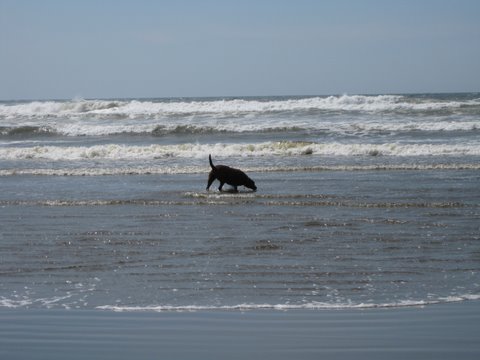
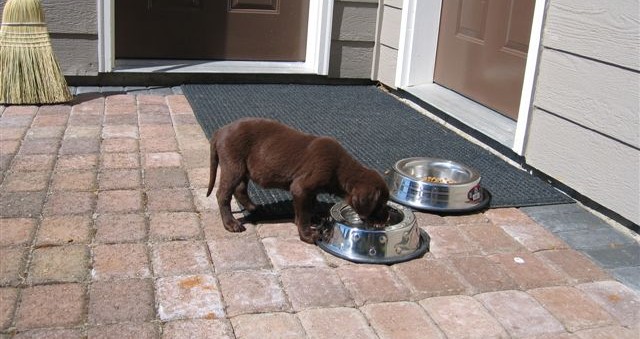
Your conscious mind is a point in space moving through your brain like a red blood cell moving through a Labrador retriever as she runs.

Your subconscious mind is the dog herself – the whole animal except for that one red blood cell. At any point in time, nearly your entire brain functions subconsciously where you can’t sense it.

This puts most of your writing talent in the background, unseen and unexplored.

The subconscious mind is not exactly “you,” but it’s pretty close. It’s probably more like the person you would be if you were a Labrador retriever.

It’s a useful metaphor: You carry a Labrador retriever around in your head.

She’s the keeper and processor of all your feelings, your memories and your talents. You might think she’d be as sharp as a tack, but compared to your conscious mind (the actual “you”), she lives in a bit of a fog.

For instance, she’s not clever at differentiating real things from pretend things. Dreams and TV can sometimes be almost as real to her as ordinary life. If you show her mainly upbeat things, she stays happy.

She doesn’t always know if you’re joking when you poke fun at “yourself.” She’s apt to take you seriously when you turn away compliments by saying that you don’t deserve them.

Like any dog, she needs a leader, even though she may want only followers. If you fail to lead, she becomes neurotic. If someone attacks you verbally and you don’t defend yourself, she feels abandoned and defenseless.

Some things must be said to her many times before she understands, while other things need be said only once. If you want to tell her that she did a great job, you’ll have to say it several times slowly or she’ll be too distracted to listen. If it’s not a crisis, she’s not focused.

The passage of time isn’t linear for her. Work can feel like torture or fun, depending on what it is. If you give her the job she was born to do, she will work until she keels over and your arm falls off from throwing the ball. She won’t know where all the time went or why you want to stop playing so soon.

All these points are probably relevant to writers, but it’s the last one that new writers would do well to grasp and believe.

The key when you start your journey of writing fiction is to figure out what you were born to write. When you find the things that your subconscious mind loves to create, the work of writing disappears and is replaced by one of the best experiences of your life.

Here’s a way to discover what your subconscious Labrador retriever wants to write about:

1. Read the first ten pages of several dozen popular books from various genres. Pick out your favorite two.

2. Turn your monitor off and write the first six to ten pages of a dozen stories that are similar to those two books in terms of mood and characters, or whatever made you choose them.

3. Repeat steps 1 and 2 until you feel a sudden compelling love (or other strong emotion) for one of your characters.

4. Begin a novel immediately with that character in it.

After you’ve found the character who turns writing into fun for you, it’s probably best if you don’t write any more practice stories. It’s better to work on your ultimate goal from the start. Otherwise writing can feel like school in the sense that you’re preparing for “someday” when you’re “good enough” to face the real world.

You’ll become “good enough” a lot faster if you’re working on the real thing. If you work on it in the “real world” of a blog, where people are watching, it will probably help you improve even faster.

In some genres, short stories are part of the real world. If that’s the case for you, it might be wise to crank out a dozen short stories and submit them before you start your novel. But when they are all rejected, don’t feel bad, it’s the norm. It has nothing to do with how much talent you have or how successful you can be. It merely reflects the story to publisher ratios.

As long as you’re working with a character who moves you deeply, on a story that you plan to submit, you’re working in the real world on an achievable goal. Hang tough and never give up.

In my opinion, the real world is a place where good things happen to the few who love their work.

M. Talmage Moorehead


Writing Cite

579604_483298398398105_1953544274_n (1)-004

I used to have another website at http://www.writingcite.com where I posted excerpts from successful writers. The site was a tool for learning the magic side of story telling, the part that can’t be communicated in how-to books.

Years ago I read a book that said you should transcribe famous authors’ stories word for word so you can learn their subtle techniques. In getting that other website up, I did some transcribing and found it more instructive than I expected. I think it really helped me.

Anyway, I didn’t have enough time to keep posting over there, but the lesson I learned from typing pages of successful author’s work was worth the trouble. The things I absorbed can’t be put into words, but I think you should consider trying it.

If you have time.

M. Talmage Moorehead


The Predator’s Laughing at You, Kid

I’m quoting an Egyptologist as he tells us how stupid we would be to disagree with him:

“I laughed the first time I read that idea somewhere in a more speculative forum.”

7938_3276637876133_322590165_n

.

.

.

.

.

.

.

.

.

.

.

No matter the topic, the tone of this quote embodies the most convincing argument against any idea, especially an idea that can’t be refuted with hard data, logic or reason.

The haughty, condescending put-down laugh IS The Predator.

Unless we inoculate ourselves, we become trophies of the “informed” elites in any field, the wielders of the laugh.

History is heavy with experts laughing down innovators and thinkers. But some underdogs prevail.

Pathologists look at tissue sections under a microscope to see if a patient has cancer. The malignant cells invade tissue. The slide is a “snapshot” of the action: killers and victim fighting and dying with their hands on each other’s throats.

Once upon a time in real life, a non-pathologist outsider had the gall to scrape cells off the cervix in search of cancer. He said he could look at the killer cells and identify them without seeing their victims. (Cytology.)

“Absurd,” the pathologists said. Smearing loose cells on a glass slide? They laughed the outsider to scorn and said:

“He isn’t even a pathologist.” Snort!

If you can get this kind of laugh on paper, it will improve your story.

The outsider was the great Georgios Papanikolaou. His absurd idea (the Pap smear) has already saved the lives of over six million women.

Although his findings were published in 1928, many pathologists hate and despise cytology to this day. (I’m a pathologist and I’ve heard the disdain.) That’s the power of “the laugh.” The predator’s laugh.

It’s the most effective argument against anything, at least in the short-term.

Truth prevails eventually, though. It may take centuries.

Your story’s character might be too smooth to say, “It’s amusing how intellectually beneath me you are,” but you can let his laugh says it all for him.

Using the put-down laugh against your hero makes her enemies seem to be people from a culture where “experts” have incubated traditional ideas for generations.

If your hero suffers public humiliation at the experts’ laugh, she becomes sympathetic, closer to the reader’s heart. Her refusal to cave in to authority shows moral courage.

See if this illustrates the laugh at all:

Joey finds a way to beat the stock market. He needs seed money.

He goes to grandpa who’s made his fortune as an entrepreneur, pulling all-nighters, paying employees instead of himself, bankrupt twice, lost his house, but finally made it in business.

Joey makes his plea for money to Grampa, who says…

“That’s nuts, Joey.” He looks at his wife and smirks. “If…” He suppresses a laugh. “If you could make money on your ass.” He looks at Joey “What pressing buttons?” He chuckles. “Everybody would be doing it, Joey. Hell, why work?” He looks at his wife. “I’ve been a fool all these years!” He raises his hands and shrugs.

Joey’s lips won’t move for him anymore. He presses them together.

Grandma sees his face and stops laughing. “Joey, honey,” she says…

If your hero is part of an elite group, then “the laugh” can be directed at the bad guys. This helps convince the reader that the good guys believe they are true experts.

The arrogant put-down laugh has another relevance to writers…

I knew a gifted writer who was convinced that writing popular fiction would make him a prostitute.

He became a lawyer and hated his life.

No logical argument can be made against paying a writer for her work.

Those who feel a need to keep gifted writers away from money resort to name-calling (whore) and chuckling warmly downward from moral and intellectual high ground. Supposedly. But they make me sick.

Imagine an NBA basketball coach telling his star, “You’re better than this. You shouldn’t be on TV making money. You have the soul of a great basketball player. Don’t be a whore in the NBA. Go back to college ball.”

Do you see a fundamental moral difference between fiction writing talent and other rare talents?

I don’t.

Write for love, but get paid, too. If you possibly can.

M. Talmage Moorehead

Note: That picture up top is a statue of The Predator. I did some effects to try to make it look infrared. Remember how the Predator laughed at Arnold at the end of the first movie? The alien hunter lay there half dead, ready to blow himself up and take Arnold with him. That was a nice put-down laugh.


Viewpoint Character as Author

Should it be the author or the character who tells the story? How should that story-teller sound in print? The answers make a walloping difference.

7-30-09 Mt Bachelor and Museum 007


I’ve read conflicting views. Rarely is the subject discussed directly and insightfully.

That’s not going to happen here, either.

In The Hunger Games, there’s a convincing answer demonstrated by Suzanne Collins, the best-selling author…

Katniss says (as she writes to the reader), “I peel off my mother’s blue dress and take a hot shower. I’ve never had a shower before. It’s like being in a summer rain, only warmer.”

Collins’ “voice” isn’t getting in Katniss’ way. Collins isn’t trying to achieve a voice for the sake of literary self-aggrandizement.

In terms of voice, Collins and Katniss are identical. In Collins’ next novel series, expect to hear a different “writing voice,” one that matches a new viewpoint character perfectly. Expect comments from the critics to emphasize the change in Collins’ writing voice. They won’t like the change, that’s a given.

They’re paid to criticise, for the love of sanity! What planet?!

When Collins tells the reader that Katniss is taking off her dress, she uses the verbs, the vocabulary and the style that anyone would expect from Katniss, a girl who talks clearly and simply, never puts on airs, hunts dangerous game, and probably wouldn’t get comments from her District 12 English teacher saying, “clever twist of phrase,” or “wonderful use of simile, Katniss!”

But if a hack were trying to get an A on a story assignment in a creative writing class, do you think I’d write, “I peel off my mother’s blue dress…”?

No, laddie, I would not.

I’d be looking for something like, “I throw off my mother’s cyan plumage…”

Gag me with a blunt instrument!

And in writing this way I’d be making a horrible mistake that might draw a good grade: I would be telling the story myself rather than letting Katniss tell her own story.

I would be placing a barrier between Katniss and the reader, creating a translator:  A man in a suit standing in front of her, paper in hand, translating her gruff, honest, simple words and raw emotions into the “elevated” verbiage of literary sophistication.

OK, I’d be trying desperately and not succeeding, but still.

This would ruin the consistency of Katniss as a character and make her less real.

The reader, in the back of her mind, would be asking, “Who the devil is telling this story? Isn’t Katness a teenager in poverty? Where did she learn big words?”

The rawness, honesty and directness of Katness’ emotions, the thrilling feeling that “she’s talking right to me,” the respect we have for Katniss and others who don’t put on airs… all of this would be lost.

Why would an author want to lose all this gold?

Answer:  Because she hopes that some supercilious critic will say of her, “What a powerful and distinctive voice!”

This is toxic motivation that yields self-consciousness, collapsing the wave function of your magic spell as a writer.

When you write in first person it all becomes clear. But when you don’t, it’s murky and critics may not understand. Especially if you have multiple viewpoint characters.

I know from painful experience…

In earlier drafts of my story, I changed viewpoint (vp) characters from one chapter to the next. One vp was a doctor, another a genius (Johanna), another had autism, another was an evil person of high intelligence, utterly mad.

I dared to let each vp character “write” his or her own part of the story in third person. Johanna, my genius vp used bigger words and longer sentences. She carried the mood of a brilliant scientist. The doctor – a pathologist – when he was vp, used comparisons to gross things with technical words, and carried an angry mood of discontent. The autistic boy as vp wrote with small words in short, often incomplete sentences that didn’t make adult sense (cause and effect were backwards sometimes). He carried the mood of an innocent child who was hopeful and trusting but bewildered. The villain as vp, carried a dark, depressed, angry, remorseful mood, and used aggressive verbiage with a vocab that reflected her ancient roots and the influence of her first language, now extinct.

Trouble was, I emailed a small piece of the story to a well-read friend. The small piece had the young autistic boy as vp. My friend read the thing and thought I couldn’t write. He probably thought that I needed to learn basic sentence structure, the meaning of word economy (tight prose), and a few zillion vocabulary words.

Although he’d read ten times as much fiction as I had, he didn’t understand what I was doing. I tried to explain that I’d attempted to write in the style and voice of each viewpoint character whomever it might be in the current chapter. He said, “Boy, you’re really getting into this, aren’t you?”

Yes, I am. It’s the thing I would do with my life – if only I could. (Update: now I’m doing it. Wheee!)

The rules and expectations of readers change from decade to decade. “Gone With The Wind” was a page-turner that raised eyebrows in its day. It was so “evil” to the missionary parents of one lady I knew that they disowned her after she read it. Now it’s literature. Try to convince a teenager to read it. Heck, try to convince me to read it. A few pages in and I’m done. (I’m not a gifted reader.)

Writing fiction is infinitely more art than science, so the rules change on cultural whims. To fight this reality is to tilt at windmills.

So I’m going with Collins and Katniss on this one:

I’m letting the viewpoint character tell her own story. As her writer, I’ll step aside. (Update: her story is in progress and starts here.)

If eleven quadrillion people should suddenly read my story and agree that it’s not literature, I will have accomplished everything I set out to do… to write a meaningful page-turner that my grandkids will open and finish without a bribe.

If fifty years later my story has reached trillions more, including the alien species in formaldehyde at Norton Air Force Base, then perhaps the critics will decide that my story was literature all along. Whoo hoo! Look, Mom!

But their decision will mark the end of my story’s popularity, putting it out to pasture as required reading for literature classes and those really smart kids who are always their own generation’s gifted readers.

M. Talmage Moorehead

(not “Talmage Eastland” anymore)

By the way, “Talmage Eastland” was my pen name for awhile, or – since I’ve never had any fiction published, it was my “fake name.” I used it because bad credit card charges made me suspect identity theft. I wasn’t paranoid. It’s just that I didn’t want the CIA to come and steal the UFO’s from my basement again. (Just kidding. 😉 They never found them.)


Valuable Procrastination

032_32
When I sit down to write, I have a tendency to do all the things you do, check my email first, look at my blog stats, answer the rare comments (edit note: actually I later learned that they were all spam, I still haven’t had one single comment), use the free “One Click Cleaner App” for Chrome, fiddle with things to get my computer to exit turtle mode…

Sorry for the boring detail, but…

Two bits of procrastination are essential to me:

1. I read a few pages of a best seller very slowly, breathing in the emotion.

2. I read excerpts of great dialogue from the “Great Dialogue” program.

Aside from a good night’s sleep, these two habits improve my writing more than anything.

This morning I was floored when Katness first met Peeta as a child (in Collin’s Hunger Games). I dropped everything to write this for you.

I had to type the excerpt. (You can’t cut and paste from Cloud Reader.) So please read what Collins is saying here, don’t skim it. Skim my stuff, not hers.

I’m going to bold the places where I see character emotion. See what I’ve overlooked…

From The Hunger Games by Suzanne Collins:

“But the money ran out and we were slowly starving to death. There’s no other way to put it. I kept telling myself if I could only hold out until May, just May 8th, I would turn twelve and be able to sign up for the tesserae and get that precious grain and oil to feed us. Only there were still several weeks to go. We could well be dead by then.

“Starvation’s not an uncommon fate in District 12. Who hasn’t seen the victims? Older people who can’t work. Children from a family with too many to feed. Those injured in the mines. Staggering through the streets. And one day, you come upon them sitting motionless against a wall or lying in the Meadow, you hear the wails from a house, and the Peacekeepers are called in to retrieve the body. Starvation is never the cause of death officially. It’s always the flu, or exposure, or pneumonia. But that fools no one.

“On the afternoon of my encounter with Peeta Mellark, the rain was falling in relentless icy sheets. I had been in town, trying to trade some threadbare old baby clothes of Prim’s in the public market, but there were no takers. Although I had been to the Hob on several occasions with my father, I was too frightened to venture into that rough, gritty place alone. The rain had soaked through my father’s hunting jacket, leaving me chilled to the bone. For three days, we’d had nothing but boiled water with some old dried mint leaves I’d found in the back of a cupboard. By the time the market closed, I was shaking so hard I dropped my bundle of baby clothes in a mud puddle. I didn’t pick it up for fear I should keel over and be unable to regain my feet. Besides no one wanted those clothes.

I couldn’t go home. Because at home was my mother with her dead eyes and my little sister, with her hollow cheeks and cracked lips. I couldn’t walk into that room with the smoky fire from the damp branches I had scavenged at the edge of the woods after the coal had run out, my hands empty of any hope.

I found myself stumbling along a muddy lane behind the shops that serve the wealthiest townspeople. The merchants live above their businesses, so I was essentially in their backyards. I remember the outlines of garden beds not yet planted for the spring, a goat or two in a pen, one sodden dog tied to a post, hunched defeated in the muck.

“All forms of stealing are forbidden in District 12. Punishable by death. But it crossed my mind that there might be something in the trash bins, and those were fair game. Perhaps a bone at the butcher’s or rotted vegetables at the grocer’s, something no one but my family was desperate enough to eat. Unfortunately, the bins had just been emptied.

“When I passed the baker’s, the smell of fresh bread was so overwhelming I felt dizzy. The ovens were in the back, and a golden glow spilled out the open kitchen door. I stood mesmerized by the heat and the luscious scent until the rain interfered, running its icy fingers down my back, forcing me back to life. I lifted the lid to the baker’s trash bin and found it spotlessly, heartlessly bare.

“Suddenly a voice was screaming at me and I looked up to see the baker’s wife, telling me to move on and did I want her to call the Peacekeepers and how sick she was of having those brats from the Seam pawing through her trash. The words were ugly and I had no defense. As I carefully replaced the lid and baked away, I noticed him, a boy with blond hair peering out from behind his mother’s back. I’d seen him at school. He was in my year, but I didn’t know his name. He stuck with the town kids, so how would I? His mother went back into the bakery, grumbling, but he must have been watching me as I made my way behind the pen that held their pig and leaned against the far side of an old apple tree. The realization that I’d have nothing to take home had finally sunk in. My knees buckled and I slid down the tree trunk to its roots. It was too much. I was too sick and weak and tired, oh, so tired. Let them call the Peacekeepers and take us to the community home, I thought. Or better yet, let me die right here in the rain.

Dude!

In my story, Johanna is still exploring the inside of an ancient sub. I was reading my story from the top, trying to judge it as a reader. Objectively. It’s impossible, really.

I’d already re-written the first chapter to add emotion. This kind of thing…

To description, I added an emotional reason why she was looking at things. I’d given some objects internal emotional content. I’d tried to tell and show the reader how the scenery and settings make Johanna feel.

To dialogue, I added quantity, diversity and motivation to the emotions, not just brittle personality clashes that may drum up superficial tension without developing character or sounding genuine…

I mean, not too much of this:  “Oh, you would say that, you’re such a critic,” she said. “I’m a critic?” he shot back. “You should talk! You’d find a flaw in Noah’s rainbow.”

When I do too much of this, it seems falsely motivated, more lashing-out and histrionic than justified. It has the wrong echo because it’s hollow and thinly motivated. It becomes an end in itself and takes my eyes off the big picture… what is the nature of the main concern at this point, and how likely is it that two people whose lives are in danger would exchange flirtatious insults that they don’t really mean?

Instead, I wanted to bring in a broad spectrum: hope, pride, fear, love, affection, loyalty, thankfulness, anxiety, apprehension, dislike, loathing, disdain, anger, hatred, and the anaphylactic reaction I’ll get to in a sec.

But I had only done my emotion edit to the first chapter, not the rest.

Reading my first chapter got me involved. I felt an almost certain ray of hope for my writing.

Then Johanna and Max got into the ancient sub that I mentioned a few blogs back, and she was fascinated. So much so that fascination was the only emotion. After a few sentences I wasn’t feeling it with her. The dialogue went cerebral: explanations of technology. The story fell flat for several long and painful pages.

Finally Max felt claustrophobic. A new feeling for the scene! Johanna switched from fascination with technology to concern for her friend. I was interested again. She took charge and helped him cope with his feelings. The story was back! My career was not over! Why won’t anyone read this thing, it’s great!

So, yeah, today I re-learned something that I thought I’d learned before. I’d told you about it a few blogs back: Emotion drives all the stories that I enjoy reading.

And I’m not alone. Or am I? A few days ago…

I caught a conversation of J.K. Rowling, the author of the Harry Potter series, talking with Steve Kloves, the screenwriter.

Tucked into that generous, soul-searching exchange, Rowling said she is “allergic to sentimentalism.” Kloves agreed. Rowling’s body language was speaking of no small allergy, it was anaphylactic. She hated this horrible thing, sentimentalism, exactly the way I hate drowning in rivers now. (Details in a previous blog.)

I wish I knew what she meant by sentimentalism.

This hack writer hears Rowlings’ abhorrence of sentimentalism and says, “Gee, maybe I shouldn’t show my character’s feelings.”

My wife thinks Rowlings was talking about becoming too sentimentally attached to a character to let go (“killing off one of your babies”), when the plot demands it. Hopefully my wife is right, as usual.

I wish I could ask Suzanne Collins what Rowling’s meant.

But until then, I’m going to forget about trying to make myself “allergic to sentimentalism,” because I don’t know what it actually means.

I do know that if I fail to do a deliberate, conscious re-writing for the specific purpose of fleshing out and spelling out character emotions, my story reads like a textbook.

“My knees buckled and I slid down the tree trunk to its roots. It was too much. I was too sick and weak and tired, oh, so tired. Let them call the Peacekeepers and take us to the community home, I thought. Or better yet, let me die right here in the rain.” – from Collins, The Hunger Games.

M. Talmage Moorehead


“Tight Prose” vs Imagination and Personality

800px-Storiform_pattern_-_intermed_magCreating tight prose is something you’ll get patted on the back for. (<dangling participle!) But honesty and imagination draw fiction readers.

To write anything in tight prose, I have to edit like a madman: avoiding dangling participles, eliminating pawns, rephrasing weak passages, swapping verbs, getting out the thesaurus but not overusing it, cutting viciously and ignoring sanity.

When polished to the bone, tight prose, or I should say, my hack assaults on it, sound pretentious, stripped of personhood, snippy, and a little unimaginative. Rarely does it resemble anything you’d call a unique writing voice.

But if you’re a genius with words, and you always have something novel to say, in a few years or decades someone’s going to tell somebody that you’ve got a unique writing voice. They may say it’s strong. Oh my!

Of course if you don’t have anything new to say, all the tight prose in the world won’t draw accolades.

On the other hand, if you focus on new and interesting ideas, feelings, personalities, plots and places, readers may discover you, especially if you let your honest personality come through, cherishing your own natural speech pattern a little, and not leaning too heavily on the thesaurus.

Here’s a snippet of my “tight prose” that’s beyond dead…

The dermatofibrosarcoma protubrans (DFSP) displays a storiform pattern on routine hematoxylin and eosin stains. Most DFSP’s express CD34, however, a minority lack this typical immunohistochemical phenotype. DFSP’s may recur if incompletely excised. Five percent metastasize.

“Data to Enterprise.”

Incidentally, I spent too much fearful time on that, knowing that a non-hack could point out where I screwed the pooch. Is it “a minority lack” or “a minority lacks”? Logic says that a minority is a singular thing, despite its many components, so it “lacks.” But to me “a minority lack” sounds better. At least it did before I thought about it.

Who cares, right? It doesn’t matter to the friendly, non-judgmental person I care about – my one reader.

I try to think of my one reader as someone who’s on my side before I start, pulling for me to come up with something worthy. Ignoring typos and saying, I know this is going to be good, come on!

Critics? Professors? Callous sophisticates? No. They despise doctors.

I’m not paranoid, that’s just silly. You’re jealous because the voices only talk to me.

(Is that from MASH?) Ha! I love that line.

Here’s the exact same DFSP snippet, except with something interesting thrown down, and not much concern for tightness:

I wanted a great name for a website. Clever and maybe just tangential to the topic – which I figured would be the final word on writing fiction. Sweeeeet! For awhile though, I wanted to dive into something else, like those weird rocks in Puma Punku. You know, Peru – or is it Bolivia? – twelve thousand feet high? Giant stones that weigh, what, twenty tons? Some architecturally designed by a genius and cut from cliffs with a technology that re-writes ancient history. They’ve got these huge smooth flat granite surfaces, modular H-designs, there’s this perfectly straight, uniform groove a few millimeters across running down the side of one! You’d have to see it to believe it. But they tell us that it was all cut with soft metal and chips of stone. Something like that. And also carried for miles up steep slops by primitive people who had no wheels and no written language? I, for one, don’t buy it. I may be stupid, but… Google Puma Punku for yourself and click on the “images” thing. I guarantee you, you won’t come back to this blog any time soon because, unfortunately, I decided not to write about impossible rock-work. That’s all you’ll be thinking about for weeks now. Hey, I just found this site, check it out: http://www.world-mysteries.com/mpl_PumaPunku.htm  No, it’s not my site, don’t worry. Anyway, instead of Puma Punku, I went with fiction writing and came up with, “Storiform.com,” because it’s a pathology term (for the dermatofibrosarcoma protubrans) and it sounds like “StoryForm,” which is what I really wanted. Oh well, “Storiform” is probably better… in some vague way that hasn’t occurred to me quite yet.

See, the two paragraphs are exactly the same… except that they’re entirely different.

I focused on novelty the second time, and went overboard with the grammar, normal words, and the dim-witted “voice” that comes so naturally to me. Also I set aside caution, letting my ignorant arrogance fly in the faces of established archaeologists who, unlike me, know what they’re talking about.

So here’s your hack’s infallible opinion on tight prose: Be careful of it because it can become an end in itself and a viral preoccupation, stripping your work of personality and taking away the freedom that honesty gives the imagination.

True, a writer needs economy. My second rendition proves it. Too much flab. Tough to get to the end. Efficiency is easier for the reader, true. And an unholy excess of fluffy words causes readers to reach for something easy to strangle. True.

But you really need words that are not essential to anything but the whims of your own personality if you’re going to sound unique, if you’re going to be confidently imaginative.

M. Talmage Moorehead

Note: The picture up top is a high-power shot of a storiform pattern from a DFSP on a light microscope. Click on it and the image becomes sharper. Woohooo!


Cliche Purging, Forget About It

Clichés, like just about any other biological thing, can be placed on a nearly bell-shaped curve. With clichés, there are a few outliers on the left tail that are essential to basic communication, and a few on the right that actually deserve a speck of a writer’s attention.

Some from the left tail we don’t even call clichés: IMG_2260

“In other words…”

“If only I could have…”

“I’m sorry, but…”

“Of course.”

“I love you.”

Here’s a cliché of sorts from the right tail of their bell curve:

“The only thing we have to fear is fear itself.”

You probably recognize this from a political speech by FDR. If you use it in a story, your editor (I wish I had one) may balk and write, “cliché” beside it with three exclamation points to grind your limbic system into eternal shame.

FDR’s words are relevant to writers who are afraid of clichés.

I was in high school when I first felt the dark power of cliché purging. I didn’t know what the teacher meant by the word, but pretended to get it because her body language was telling me to feel sheepish, and I didn’t want to add to that by admitting I was an illiterate slug.

Years later, the many books I read on writing fiction stressed the “poisonous” nature of clichés and their power to kill anything living for pages around.

The books needed only to warn me once.

The fear of fear itself  can be strong, but the fear of humiliation is stronger.

One time I literally put my life in danger just to avoid humiliating myself in front of an unseen hunter who had fired his shotgun into the fog at birds that must have been near me. I was too worried about embarrassment to shout, “Don’t shoot!” I didn’t say a word. And now I’m too ashamed to tell you all the details.

Needless to say, some fearful people will kill the flow of their writing to avoid clichés and that peculiar flavor of humiliation.

Forget cliché purging, already. Writing spell-binding stories requires every neuron in your head. If you keep some neurons busy hunting self-consciously for clichés, you’re diminishing the quality of your work. Your focus has to shift back and forth from creativity to self-defense.

The more  you focus on the words, the more you ignore the magic.

Of course, there are those who have read so much fiction that “the story” is no longer where magic lies for them.

My former brother-in-law, a well-read man, used to find a transcendent euphoria in an ethereal quality of the words themselves. Their rhythm, their flow.

It’s not that I can’t relate. I love some of Robert Zimmerman’s (Dylan’s) lyrics for similar reasons (feelings) that I can’t put my fingers on. This passage, for example, is magic to me – from One of Us Must Know (Sooner or Later)

“and I told you as you clawed out my eyes that I never really meant to do you any harm.”

And this, from Visions of Johanna

“The ghost of electricity howls in the bones of her face where these visions of Johanna have now taken my place.”

To me, the magic of words is found primarily in poetry, while the magic of a story lies almost entirely in its characters and the grip of the plot on their lives.

I can imagine that a cliché might poison a poem.

I doubt that a cliché could give a sniffle to a page-turning novel. Maybe an army of clichés could.

But I know from personal experience that cliché purging produces a concrete, word-conscious and timid writing session where nothing comes to life.

Be brave.

M. Talmage Moorehead


Plot versus People, a Humble Perspective

young star

My former brother-in-law who “unfriended” me on Facebook (and also in real life) a year or two ago because my emails were getting too angry, told me once of a famous author of Westerns who sent his characters out one day on horseback in terrible weather intending to have the gang do something amazing, but – and this is the interesting part – the characters didn’t like the weather so they rode their horses back to the ranch.

What does that tell you?

The relationship between some writers and their characters is, in my minuscule mind, analogous to the relationship between God and the beings of free will that he has created.  Don’t worry, this isn’t getting religious…

Imagine God feeling alone. We’ve all been there. Imagine he creates some “characters” to keep him company. He’s got a choice in this. He can either write an outline of a plot and place robot-like people into it, or he can do something entirely different. Something dangerous.

He can create real people.

Robots can’t keep you from being alone. So God wouldn’t go that route.

The difference between robots and people is simple. People have freedom to: 1. make up their own minds, 2. act on their decisions and 3. enjoy (or suffer) the consequences of their actions.

If you take away any of the three, you’ve created robots, not people. Think about it. Even number 3 is essential to creating real people.

An entity capable of  driving loneliness away from God must be able to enjoy or suffer the natural consequences of his decisions and actions, otherwise he’s just a robot that can’t provide company to a lonely soul.

You don’t see it? Yeah, of course not, I just repeated the same thing. Jeez, what’s wrong with me…

OK. There was a Twilight Zone episode where a broken gambler died and woke up in gambler’s heaven. Every bet he made was a winner. He was elated. Win after win. But when the newness wore off, he decided to make a dumb bet. He still won. So he made a downright stupid bet – still won. No matter what he did, he couldn’t lose. Suddenly, in horror, he realized he was in hell.

Without being able to enjoy or suffer the consequences of his decisions and actions, the decisions and actions were not real. He was no longer a person. Just a robot-like thing with the illusion of consciousness.

You’ll recall that James T. Kirk suffered a similar, but temporary fate in Star Trek Generations where his euphoria on the Nexus (robot heaven) turned to emptiness. No matter what he did, everything turned out just grand. He remembered what life had been like in the real world where his actions had consequences. At some level he must have realized he’d become a robot… as if he’d become a character in the hands of an over-controlling hack writer.

Now you see it.

To be real people, we need all three: 1. free decisions, 2. free actions 3. real, natural consequences.

So, as a writer, you might be able to learn something from the way God, in my current humble view of things, creates his characters.

I apologize to folk who believe that God directs most every move we make, changes outcomes, and causes every detail of everything that happens – at least the good stuff. You guys have a long history of being right about a great many things. I’m just a hack writer. Infallible, yes, but… Please just humor me, umkay?

My point is somewhere in this: I’ve got a plot outlined. It’s full of conflict. I sit down to write the plot and Johanna and the “evil” Queen meet. This happened yesterday, in fact. These two characters were “predestined”  to clash and fight to the death. But when they actually met?

They talked calmly and with respect for one another. The Queen asks Johanna to call her by her childhood nick name which nobody alive has ever heard. She explains ancient history as it truly happened. Johanna was coached by other characters to act meek, so as to avoid the Queen’s horrid temper, but my girl speaks her mind fearlessly as she’s always done.

As I’m writing, it’s as if these two characters are real and have free wills of their own.

For some reason, I never feel alone when I’m writing this novel.

But there seems to be a problem.

I can’t write a page-turner if there is no conflict. My goal is to have a zillion readers. Plus I want to say something meaningful to my grandkids who won’t read it unless they can’t possibly put it down.

But my characters refuse to fight. I keep putting them in situations where they ought to clash with the kidnappers, with the evil Queen, with the guy who tried to blow up Maxwell in his office….

But like me, they usually avoid conflict and tension. (Except in emails?)

What should I do?

If I were a creative writing professor, perhaps I would take a total hands-off approach and let the characters write a boring plotless story. If I were a control freak with a ton of self-control, I might follow my outline to the letter and ignore anything organic that happens on the fly with the characters.

But I’m somewhere in the middle. I don’t take either approach. Neither should any writer who wants to unveil part of her soul to fifteen bazillion readers.

So I pivot between a predestined world of robots (my plot outline) and my respect for personhood – the characters’ freedom to decide, act, and experience the fate they’ve created; their ability to keep me company and give me this feeling of love that I have for some of them.

Personally, this is how I believe God interacts with people. Not all hands-on, not all hands-off.

As I write, it’s a balancing act. I want my characters to be as much like real people as I can make them, but I also want them to have interesting, novel lives.

After all, I’m writing a novel, not creating the Universe.

M. Talmage Moorehead


Writing in First Person Totally Kicks Ass

orca-san-juan-island-off-lime-kiln-point.jpg

Best selling stories are impossible to put down after ten pages or so. What hooks me is the bond I feel with the main character. I have to sense that she should be a friend of mine.

As my son the psychologist-in-training tells me, so far the only scientifically documented difference between people with friends and people without friends is their ability to share feelings.

If you want your reader to love your hero, that protagonist has to share her feelings with the reader, but not necessarily with the other characters.

The single most effective way to nudge your work in this direction is to write in first person. (“I” instead of “he” or “she”.) This makes it seem like your hero is divulging secret emotions to the reader in a way that she wouldn’t do with anyone else in the world.

Here’s an example from The Hunger Games, by Suzanne Collins:

“I want to tell him that he’s not being fair. That we were strangers. That I did what it took to stay alive, to keep us both alive in the arena. That I can’t explain how things are with Gale because I don’t know myself. That it’s no good loving me because I’m never going to get married anyway and he’d just end up hating me later instead of sooner. That if I do really have feelings for him it doesn’t matter because I’ll never be able to afford the kind of love that leads to a family, to children. And how can he? How can he after what we’ve just been through?

“I also want to tell him how much I already miss him. But that wouldn’t be fair on my part.”

You might say there’s not much dialogue in The Hunger Games. That’s true, except for the fact that it’s all dialogue.

The whole story is Katniss talking to me. Occasionally she looks over into my eyes while I’m reading to see if I really get what she’s just said. You know?

It’s possible for the hero to talk fairly directly to the reader in a second-person story, too, but it’s more difficult, sometimes awkward and less intimate.

See if I’m right. Here’s part of the same passage of Hunger Games with one small change, it’s now re-written (ruined by me, please forgive) in second person:

“She wants to tell him that he’s not being fair. That the two of them were strangers. That she did what it took to stay alive, to keep them both alive in the arena. That she can’t explain how things are with Gale because she doesn’t know herself…”

To me this sounds relatively clinical, removed from the raw emotion.

Now I know what you’re thinking… you were wondering what I did on Dec. 27, 2012.

Here’s the true story. I’ve written it in first person.

There were three of us. The white water sucked us downstream toward a giant log that had fallen across Washington’s Elochoman River, blocking the whole thing.

Just before aluminum hit pine, our guide, the only man in the drift boat with any experience shouted, “We’re going to lose the boat. We’re f~~ed!”

I didn’t say anything, but I wondered how badly f–ed we were exactly. Certainly he didn’t mean dead. Did he?

We hit the log and stopped instantly as the river rushed on around us. The guide and my son-in law crawled out to the left on the log, but I had to crawl out to the right because there wasn’t time to stand around waiting for the boat to flip. On my side, the log tapered to about the width of a telephone poll. It might have been slippery, I think. My left knee slid off and before I knew it, I was dangling with my legs downstream in the whitewater.

If I’d fallen to the right, on the upstream side of the log, I would have been dragged under and, hopefully, pushed out the other side. But people don’t generally make it all the way under logs in these circumstances. They get dragged under, and they drown. So I’m told.

Next thing, I hear the guide’s terrified voice, “Oh no, Talmage!” Too ignorant to be afraid, I said calmly, “I’m cool. I can hang here all day like this, no problem. Save your boat.”

I dangled there as the whitewater pulled my camo pants down over my ankles. It sounds pretty, but my jeans stayed up, so we’re good. My fingertips found bumps on the log, and I held on there for the longest time while the other two saved the boat.

When the big guy, my son-in-law, came over, he grabbed my right wrist and pulled like hell, but I must have weighed a lot more than usual with the wet coat and wet jeans, and boots full of water, so he finally had to give up. Actually, I had to convince him to give up, and then insist that he let me go.

“OK, let go!” I says. And he does.

The December rapids took me, and honestly, the water felt warm compared to the idea of drowning. Breathing water scares me a little.

With my outer pants around my feet like chains, I couldn’t swim much, but I finally found the bottom of the river with my feet and pushed off toward the edge, caught a small log that was hanging from the bank, jumped up and crawled onto it. It must have taken me fifteen minutes on that log to undo the velcro around my ankles and free myself from those camo pants. I felt old.

And lucky.

But let me tell you something that went through my head while I was hanging by my fingertips off that first log, waiting for my son-in-law to hopefully fish me out. It was a prayer. Don’t worry, I’m not going to get religious on you. I just want you to hear what I said, verbatim:

“I hope you can get me out of this.”

That was it. There wasn’t any, “Dear God,” or “please” or anything else.

Obviously I’m not saying a miracle was involved, or that my mortal hide is worth God’s time in any way. I just think my prayer sort of shows where my head’s at with this divine intervention thing.

I’m not sure, but I think God’s hands are sometimes tied by the cause-and-effect web of our own free choices. Our free wills. Without natural consequences, there couldn’t be free choice. Therefore sh-t must happen if human beings are going to exist in a non-robotic state.

If the deacons will please rise for the morning offering. Sorry, was that too religious?

First person story telling, though. I like how it feels, don’t you?

Suppose someone told you that same story in second person. It wouldn’t feel like we got to know each other at all, would it?

Writing complex stories in first person is said to be difficult or impossible because a vp protagonist can’t be in more than one place at a time. That’s got to be true, I guess.

But what’s more important to you, touching millions of people with your soul, or writing a grand, complex story that only a few beyond your inner circle of brilliant writers will ever appreciate?

There are many reasons why writing in first person isn’t the default mode for most authors. I get it. I myself am not yet comfortable writing my female protagonist’s story in first person, because I don’t know what it’s like to be a woman, and I doubt I could fake it in first person where everything is raw and totally exposed. And I’m too in love with my protagonist to start another story without her. Maybe this is the “sentimentalism” that some great authors say they hate.

So shoot me.

But a zillion readers, all hammering through your book to the end, telling people what a night they’ve had with your hero? If you write in first person you’ll get the emotions from your hero to your reader more powerfully and more naturally than you probably will in second person. Try it if you don’t believe me.

Check this out, now. It’s Katniss again…

“As the lights dim and the seal appears on the screen, I realize I’m not prepared for this. I do not want to watch my twenty-two tributes die. I saw enough of them die the first time. My heart starts pounding and I have a strong impulse to run. How have the other victors faced this alone? During the highlights they periodically show the winner’s reaction up on a box in the corner of the screen. I think back to earlier years… some are triumphant, pumping their fists in the air, beating their chests. Most just seem stunned. All I know is that the only thing keeping me on this love seat is Peta – his arm around my shoulder, his other hand claimed by both of mine. Of course the previous victors didn’t have the Capitol looking for a way to destroy them.”

Can you feel the draw of this special person, Katniss, telling you every detail of how she feels?

 The contrast between how openly and honestly she speaks of her feeling to the reader, and how much she hides from other characters creates a bond, too.

See if you can’t go back and rewrite one of your second-person babies in first person. Or start something new in first person.

I predict that you’ll get closer to a meaningful page-turner than ever before if you dare to write intimately in first person.

M. Talmage Moorehead

Seriously, opt into my mailing list so I can pay my electricity bill someday. Email lists are a big part of that – so they tell us indie writers. I won’t spam you, share your info… I’m not even planning a “news letter” thing at this point. I won’t bug you. Please click here and we can stay in contact better.


My Dog, Cortana, is Gone Now

IMG_0948My Chocolate Lab, Cortana, the only dog anyone in my family has ever owned, or known, or loved, developed an extremely painful paralysis called “Cauda Equina Syndrome.” She had to be put to sleep by the vet.

I’m walking a line between denial and some version of “normal depressed feeling.”  If that makes sense.

I was looking out my window a few days ago, down at the grass in our back yard where Cortana had made a narrow trail of bald ground next to the fence, all the way around. I was just looking, not really feeling anything until I noticed that the grass is already starting to grow back over the trail. At that point, it felt overwhelmingly sad.

This may seem a little callous or inappropriate now, but I’ve got to share something that might help you – before I forget. This blog is about writing fiction, after all, so here goes…

If you’re trying to write a sad scene, a third-party of some sort, preferably an inanimate third-party that’s “looking on” like the grass in my backyard, makes the scene more powerfully sad. It’s not just true in real life.

Go read the poem, Little Boy Blue, by Eugene Field, and you’ll see what I mean. Second thought, here, I’ll get the poem and paste it below. If you don’t want to cry like a baby right now, don’t read it. I’m serious, this poem may make you feel depressed for a while, so be careful. Personally, I’m not going to read it now because I don’t want to cry. Yeah, I’m a guy. Shut up.

Little Boy Blue    by Eugene Field 

The little toy dog is covered with dust,
But sturdy and stanch he stands;
And the little toy soldier is red with rust,
And his musket moulds in his hands.
Time was when the little toy dog was new,
And the soldier was passing fair;
And that was the time when our Little Boy Blue
Kissed them and put them there.

“Now, don’t you go till I come,” he said,
“And don’t you make any noise!”
So, toddling off to his trundle-bed,
He dreamt of the pretty toys;
And, as he was dreaming, an angel song
Awakened our Little Boy Blue—
Oh! the years are many, the years are long,
But the little toy friends are true!

Ay, faithful to Little Boy Blue they stand,
Each in the same old place—
Awaiting the touch of a little hand,
The smile of a little face;
And they wonder, as waiting the long years through
In the dust of that little chair,
What has become of our Little Boy Blue,
Since he kissed them and put them there.

 …

Two months later… Today my wife was in the room where we used to keep Cortana’s collars. My wife was always trying new ways to get the smell out of those things. Detergents, vinegar, Clorox.  Nothing worked. Today she sniffed each collar carefully, one after the other, but none of them carried any scent. She said she wished she hadn’t washed them.

M. Talmage Moorehead


Real Life Lessons for Your Characters

IMG_1420My son is a psychologist, fresh out of school and still working for free to get his required hours.  He tells me that there are scientific studies that explore the differences between popular people with lots of friends and unpopular people with no friends. The only difference that achieves statistical significance is this:

People who wind up having many friends are those who share personal feelings. People who don’t share personal feelings can do everything else the popular people do and still have no friends.

It’s not how well you listen. It’s not how introverted or extroverted you are. It’s not whether you “get them talking about themselves.”

It’s whether or not you can share honest personal feelings.

Have you noticed how popular Katniss is (from Collin’s best seller, Hunger Games)?  Have you noticed that Katniss doesn’t let a paragraph slip by without telling you something about how she feels? Did you know that this is why you love her?

Another real-life lesson from my son…

Giving your respect, your admiration, your approval, your emotional kindness away for free (too easily) is not normal or healthy. It reduces your value in the eyes of the people to whom you’ve given it. They lose interest in you because there’s something about you that feels worthless to them. It’s as if the price tag sets the value. Stupid, but that’s the way it is.

Your religion, like the life-long fundamentalist Christianity I devoted most of my life to, may say otherwise. I hope not.

Your genetics and childhood environment may have forced you into giving away the things that make you seem valuable as a friend. I hope not.

And really, I agree that it takes all kinds of people to make the world go around. Sometimes sacrifices have to be made for the greater good, or simply because you’re afraid or have no choice.

Just realize, it truly is a sacrifice you’re making when you give yourself, your affection, your approval away indiscriminately and unconditionally to all comers. It’s not normal or healthy, but neither are many of the things people do for a higher cause.

This is true in fiction, too. Minor characters have to scurry about kissing the feet of the villains at times. Religious characters have to sometimes sacrifice their personalities and treat everyone impartially with that special sort of love.

But don’t do this to the character who is trying to drive your story… unless the story is designed specifically for an anti-hero of some sort.

Your hero needs to express doubt to the faces of all newcomers – doubt about their trustworthiness before she trusts them. She needs to share her feelings if she’s going to have friends, yes, but only with those who have first earned her trust. If she admires anyone, that person has done something extraordinary to earn her admiration. If she’s emotionally kind to someone, it has to be someone who’s proven himself to her, or someone who is weak and has nothing that could benefit her in any way. She mustn’t be sweet to someone in order to be liked. That will bring her dislike and disdain… from the other characters as well as your readers.

Remember this stuff, it will change your life and the lives of the characters in your stories.

M. Talmage Moorehead


Writing Dialogue that Echoes

img_1375.jpgGreat dialogue echos against the insides of your skull, and bounces off every person you’ve known and stored up there.

You can either focus on the words, as some of us were taught to do, or you can focus on the thoughts and feelings of the characters behind the words. The thoughts and feelings are more important, but fortunately there’s an easy way to improve both aspects.

Here’s a suggestion: Go buy the program “Great Dialogue”:  http://www.greatdialogue.com/

It’s cheap, less than twenty dollars right now. I have absolutely no connection with it whatsoever – except that I use it and love what it’s done for my dialogue.

“Great Dialogue” is a compilation of short dialogue excerpts from excellent writers and great writers. There’s context and thoughtful comments as well. It’s even organized in an interesting way.

I use the program to prime my dialogue pump before writing. Using it gets the characters’ voices to subtly fall in line with good dialogue. I don’t even think about it. I don’t try to remember anything. It just happens.

The subconscious mind kicks in, learns things that linear analysis can’t teach, and influences the dialogue as I write. The influence wears off after awhile, so I try to use the program before every writing session.

It helps more than anything else, including anything I’ve read in writing books.

Reading excellent dialogue from a novel is a similar influence, but less intense.

Go buy “Great Dialogue,” I’m begging you.  http://www.greatdialogue.com/

As you know, to write good dialogue you need to get into the head of each character to see how the world feels from that perspective – before you try to speak.

Here’s an example of me trying to do just that… Lets’ say I’ve got two people in a small bathroom. I take the hero first. He’s standing in front of the stinky urinal about ready to say something that will advance my plot and increase the depth of his personality by showing his twists of motivation. Before I write a word, I get into his head and “remember” that he might have left the stove on this morning. His house could be burning down to the ground, even as he’s peeing. He worries too much. The smell in this bathroom is not insignificant to him. He’s a clean freak, maybe. The new hiking boots his girlfriend got him for his 20th birthday are making blisters on his feet. He hated turning twenty and now hates it more. He needs to take the ransom money to a drop-off point before 9:00 AM, which doesn’t give him enough time if traffic is bad. (The kidnappers are unreasonable bastards.) He’s getting a caffeine-withdrawal headache now because he rushed out of the house without his coffee this morning. The floor under his feet is sticky. The urinal was made by Kohler. A flying-saucer shaped pink “deodorant” bar is balanced on edge against the dome of the drain, smelling worse than anything else in the room. The guy in the urinal next to him, his side-kick and friend says, “Johnnie, we got any toll money for the bridge?”

What is this hero going to say? How about this…

He goes to check his pants pockets and pees on his shirt sleeve. “One thing at a time,” he says out loud to himself, trying to relax. “Hey, call Carol would ya? I think I left the stove on.”

“But the toll money. We aren’t getting very far if…”

“Do you have to whine so loud?” Johnnie bangs the side of his head with his one dry wrist. “Just call Carol. Soon as I’m done peeing on myself I’ll check my pockets.”

Or… when the sidekick asks him if he’s got money for the toll bridge, does he say:

“Yeah, got it covered.”

If you don’t put in the work to get inside your people’s worlds and look around at everything through their eyes – and maybe take notes – your characters are going to sound like cardboard.

After you’ve got some rough dialogue down, go back over it one character at a time. Take the hero first and go through the dialogue again, making changes only to the hero’s words. Don’t let anything take you out of that guy’s head. Forget the others until the next pass. Then do the same for another character, and only that one.

When you work your dialogue, if you’re like me, you tend to worry too much about how things are said, rather than what is being said. One key to good dialogue is to do the opposite: Think content, not wording.

Example: “I don’t care who you say your daddy is, I’m not going to lie to the people of this county just to keep your sorry ass out of prison.”

The word-centered worthless edit process that I tend to do would produce this: “It doesn’t matter to me if your dad’s the president, I won’t lie to the people of my district to keep you out of jail.”

See that? I’ve merely said the same thing with different words. Honestly, I don’t know if the first one was better or the second one.

But I know this, if I let myself, I’ll spend hours trying to tweak words until I think I’ve made an improvement. The sad thing is, in the same amount of time I could have made a huge improvement to my dialogue if I’d just forgotten the words, stopped and noticed the texture of life from the character’s perspective.

Now, about those little exclamations at the beginning of phrases…

“Jeepers, I thought you were human!”

“Son of a bitch, that’s great coffee, Marge!”

“Look, I’m just saying this once.”

These preliminary words of emphasis can go viral. You’ll be up to your teeth in them because once you’re accustomed to hearing them, your dialogue won’t feel forceful enough without them. Worse still, they can sometimes fool you into “hearing” powerful dialogue when it’s not really there.

What about using four-letter type words?

All I know is this: don’t be a lamb and use vege-bad words like I tend to do in my nonfiction writing. They sound distracting, unless they make a point about the inconsistency of a character…

For instance, a crazed pseudo-religious killer might use watered down cuss words as part of her characterization. (Misery, by Steven King?) She’d break an author’s knees but feel compelled to use baptized exclamations rather than the sinful four-letter stuff.

That works, especially for King. But he’s not going to bring us a high school bad-boy saying, “Dang it, I’m going to kick your bottom!”

Either use four letter words or forget about them completely. It’s very difficult to play the middle ground and make it sound natural.

Another impossibly great piece of dialogue advice: Overdo it. When you speak for your characters, “dance like nobody’s watching.”

Is she angry? Find an angry person in your head (someone you actually heard yelling at someone) and amplify that voice, amplify the anger, make the cutting remarks crueler, think of something stupid for her to yell about. Maybe make her less than brilliant when she’s mad. Don’t edit yourself, just let the smoke fly.

Then go back later and write it all again (save the original) as if she were an upper-class British intellectual using cold, subtle criticism without losing her temper… saying cruel things in a calm, clever way.

Now you have two extremes to compare. Contrast is where magic is born. Choose one or the other and stick to it.

Have you got a kind person? Find out what made her capable of seeing only the good in people. Then when you believe in the genuine goodness of her personality and can feel it, let her talk without any editing or self-consciousness about words.

Have the courage to use this “over-the-top” stuff you’ve written. It’s probably your best dialogue, but if necessary, it will be easier to tone it down later than to add life to something dead.

Dialogue echoes if you reach across time with famous dialogue ringing in your head. Use the “Great Dialogue” program, or something like it.

Dialogue echoes if the 3-D details and feelings of a character’s world are fresh in mind before you let him speak.

Your dialogue will echo if you write loudly and fearlessly, as if no one were watching you dance.

M. Talmage Moorehead


Emotion as Focal Point

img_0941.jpgWhen you write your next chapter, try something really different, plot the emotions of your viewpoint character. You’re probably centered on plot right now, or a spellbinding scene in your head? You’re pulling a new combination of quirks together for an interesting, round character with strong desires that contrast and clash with others.

I love that approach.

But here’s something to consider…

I’m reading Collin’s Hunger Games and scratching my head wondering what she might be doing to come up with that intense and continuous rotation of Katness through that broad array of emotions, every feeling integral to plot and scene. It’s as if the scenes and plot arise from the emotions. It seems impossible that the author came back to a dry scene and wedged in an extra expression of emotion here and there.

Collins is gifted. Maybe it all flows out of her at once, the characters, plot, scenes, dialogue and emotion. But if a lesser talent with little experience were trying to reach millions with a young adult novel, I would have to take one thing at a time. Zero in on emotions, letting everything else flow out from the feelings of the characters.

Instead of starting with plot or untested characters, I’d start with an emotion map. Everything would grow up and out from there.

Something like this:

“Viewpoint Character’s Emotions, Chapter 1 – Surprise, remorse, pride, self-loathing, love, regret, fear. Chapter 2 – Fear, relief, exhaustion, new hope, confidence, love, hate, sympathy, forgiveness, surprise, helplessness, desperation. Chapter 3 – Nostalgia, confinement, longing, loneliness, ray of hope, surprise, relief, fear, excitement, euphoria, exhaustion, love, loyalty, commitment.”

Can that even be done? I’ve never tried it, but I will. Probably a draft of my next chapter.

At the moment, I’ve already written characters, a plot that the characters ignore, scenes needing work and a paucity of emotion throughout.

This is my current process (long, tedious paragraph ahead, but well worth reading):

Johanna, my viewpoint, goes into an ancient submarine that was once a flying machine.  What are the emotions she would have in there?  She almost drowned on the way in, so she wakes up disoriented and confused with Max doing CPR on her.  It’s the closest she’s ever come to being kissed.  How does that feel? It’s new and powerful, but she pushes away.  Her mind is foggy and she’s coughing and catching glimpses of the inside of this strange vessel. This character has a curious, sharp mind. She would be analytic, excited by the novel technology as she figures out how things work. There’s a section of the control panel that the people who now run the sub don’t understand.  How would it make her feel? She’s overwhelmed by curiosity and fascination, and figures out a function that even the owners don’t know. This brings satisfaction and excitement. She would hide what she’s figured out, in case she needs it later. What do you call the emotion of hiding a secret? That’s what she will express in some way, maybe body language. She would be afraid that her kidnappers might not honor their word to leave her brother James out of the deal. She took Jame’s place to keep him safe. She would want reassurance from the kidnappers, a promise to keep their word. She would feel bold and want to threaten them if they touched her brother, but she would be afraid to bring up James name at all, for fear of drawing attention to him and getting the bad guy’s minds churning as to how they might still make use of her brother.  She would try to be hopeful that they’d forgotten about him. She’s smart and plans ahead, so she would try to get on the good side of the captors, getting them to like her, assuming that the two bad guys with her on the sub must be mere pawns in the hands of a powerful figure she’ll meet eventually. She would be afraid to meet that person.  She’s a good person so she would try not to hate the one behind the kidnapping, but it would be no use. She would plan her words for the meeting, plan threats, imagine a fight to the death. The crew would like Johanna, everyone in her past has at least respected her for her mind. The crew would speak fearfully to her of the mastermind behind the kidnapping (the Queen).  They would tell Johanna how to approach the Queen cautiously and appropriately to avoid any conflict. The Queen, they say, kills people on a whim these days. Something is wrong with her, they believe. Johanna would feel fear mixed with her anger and simmering hatred. Max, her friend, could have claustrophobia in the sub. That’s a specific and interesting feeling! Johanna would empathize and dream up a way to help him. Her ability to solve problems is almost legendary in her world of genetics, the world she’s left behind now. She would remember the place with a feeling of loss, separation anxiety and an intuitive knowledge that she will never see any of them again. What emotion would contrast with all the other I’ve got in the scene now? How about embarrassment?  OK, when Max was saving her from drowning, her legs were stuck in the coral. He pulled on her limp body so hard that he pulled her out of her jeans. When he was doing CPR on her, they wrapped a blanket around her. She’s still in that blanket. Now a while later she realizes she’s not wearing anything but her shirt. She’s embarrassed, having never been seen that way by a man before. What would she feel in addition to embarrassment? She’s going to be angry at Max for seeing her, but that is met by how grateful she is to him for saving her life.  And she’s starting to have new feelings for him, of a romantic nature. She could deny the romantic feeling, saying to herself that it’s just a normal sort of love you’d feel for any friend. Analyzing love would make her think of her brother, the person she loves more than anyone else, even herself. She would flash back on James, realizing that she will probably never see him again. She feels the loss, but even worse, she puts herself in Jame’s shoes and sees him calling her on the phone… endlessly, day after day, year after year. He would never stop. (He’s a teenager whose mind has made it to the high-functioning side of the autism spectrum.) He would only hear the lonesome indifferent ring of his phone. She sees James as an old man, sitting with his phone, calling her every evening to hear one more of the stories she would tell him every night. Johanna, sitting somewhere alone, breaks down and sobs.  Nobody sees her tears. She hides them, knowing they would make her look weak. Weak things are always attacked in the real world, she would say to herself.”

Anyway, that’s a peek into my inner process, as it stands now.

So far, this process is at least giving me the enthusiasm to write instead of checking email.  (Looking back at this article from a later point in time, I should add that this focus on emotion has improved the page-turning quality of my story, in my humble and yet infallible opinion.)

Below is a list of some available human emotions. I will use it to get past the narrow range of emotions I seem to wear out:  fear, hate, love, anger, tooth extraction.  If my emotion map idea becomes a breakthrough for me, I’ll let you know.

Here’s that emotion list, not grammatically consistent or properly spaced. I’m sorry…

fear                                 calm, exuberant, robust, buoyant, faith, trust, love

greed                               generosity

helplessness                    confidence, Self-reliance

sadness                           joy

anger                                affection, not particularly perturbed, calm

feeling entitled                   thankfulness, feeling unworthy

dissatisfaction                   satisfaction

hunger                               feeling stuffed, satiated, full, nauseated at the thought of food

feeling afraid, chicken          confident, unafraid, brave, bold, courageous

boredom                             surprised, interested, excited, overstimulated, overworked, at wit’s end

feeling alone                        feeling that you belong, feeling like a family, befriended, in love

hopelessness                      hope, sensing a glimmer of what’s possible, determined

ashamed                             proud, bloated in ego, full of yourself, arrogant, unabashed, undaunted

remorseful                            impenitent, without pity, without regret

sorrow                                 rejoicing

regretful                               justified, feeling no regrets

embarrassed                        comforted, gladdened, unrattled, unflapped, undaunted, unruffled

self-conscious                     uninhibited, unaware of himself, self-assured, mater-of-fact, open, secure

hostile                                friendly, forgiving, cool-headed

abashed                               unabashed, blatantly flaunting it

chagrined                             unabashed, not disappointed

proud, grandiose                   humble, meek, lowly, a commoner, average, sub-par, self-effacing

disconcerted                        unconcerned, comfortable with, not worried about

worried, anxious                   confident, courageous, on Prozac, ambivalent

eager, anxious to go            dreading it, bored, wishing to stay

disconnected                       in touch with reality, feeling with it, belonging, having a purpose, motivated

rattled                                 confident, composed, poised, unaffected, unmoved, unruffled

unmovable                           moved to tears, convinced, talked into it, converted, persuadable, naive

undecided           convicted, convinced, persuaded, unconfused, brainwashed, not baffled, not perplexed

indecision                    decisiveness, confident leadership, conviction, mind already made up

fazed                                   unfazed, untouched, teflon, clueless, unmoved

unfocused                           in the zone, alert, bright-eyed, awake, wired, tweaked

mortified                              unmoved, no empathy, unsympathetic, insensitive, pitiless, callous,                   unconcerned, indifferent, too narcissistic to care

miffed                                  tickled, happy, pleased

distress                               holding up, stoic, gallant, bold

disgusted                            unaffected by, tolerant of, accepting, able to ignore it, accustomed to it,

humiliation                          feeling exonerated, honor, arrogance, self-righteousness, superciliousness

shamelessness                   guilt, self-depreciation,

shame                                pride

skeptical                             impressionable, brain-washable, unscientific, naive, not jaded, non-analytic, inexperienced

guilt                                    apathy, self-justification, blamelessness, pride, smugness

uncertainty                       conviction, assured, convinced, surety, oriented, doubtless

doubt                                 certainty, grounded in faith, healthy doubt, doubtless,

insecurity                           self-assurance, self-confidence, lacking normal insecurity, lacks self-doubt

hate                                     love, indifference

indifference                        love, hate

despondent                       rejoicing, overjoyed, no longer depressed, exuberant, buoyant

discouraged                      determined, never-say-die mindset, encouraged, hopeful

cornered                          unconfined, free, not jailed, able to escape, in pursuit, in the open

I think it will be valuable to have a list of emotions beside me, keeping subtle differences and broad contrasts in the front of my quark-sized mind as I write.  Not for the sake of finding better words, but for the sake of drawing rounder characters and more gripping plots.

Subtle differences matter to my characters, but for most readers, contrast means more.

My old voice teacher used to shout, “All sunshine and no shadow is boring, M.!” He was talking about tone quality, brightness and darkness. Without one, you can’t appreciate the other because anything you hear for a long time becomes background, resetting the norm for that listener for that moment.

It’s the same deal with emotions and the characters and readers who feel them.

M. Talmage Moorehead

Note:  If character emotion interests you, you might check out my article (above), “Valuable Procrastination.” It’s an update, I guess.


“Attribution adverbs rule,” he said sardonically.

“Get off your lazy butt,” she whispered softly.

“I’m not lazy,” he said defensively.  “I’m a creative writing professor, I frickin‘ cross out adverbs all day long!  It’s hard work!”  He set his coke can gently on the coffee table.  “Especially adverbs modifying verbs of attribution,” he muttered woodenly.

She rolled her eyes and barked back, “All the bestsellers use adverbs of attribution, but what do they know!?  You’re the unpublished expert.”

Attribution adverbs, such as, “he said flatly,” are fine, in my humble and yet infallible opinion (imhayio), as long as they’re not out of place omniscient-viewpoint things (words arising from an all-knowing perspective that may not exist in your story).

Attribution adverbs need to be the viewpoint character’s interpretation of something that was spoken.

Ask yourself, “is my viewpoint character coming up with this adverb, or is it me?”

Here’s what I mean…

Example of a decent attribution adverb from the vp character’s perspective:

“‘I love to be brutalized,’ he squeals jokingly. Or is he serious? With that lampshade on his head, I’m not sure.”

The viewpoint character is telling the reader how she interprets the guy’s words.  The fact that she doubts her initial interpretation after she tells you that he was joking, makes this clear, I think.

Now here’s a hack’s “god-like” omniscient adverb in the same setting:

“‘I love to be brutalized,’ he says jokingly, though I’m just stupid enough to think he’s serious.”

Note that it’s a third-party, the all-knowing author, who has informed the reader that the guy is joking. The vp character thinks he’s serious, so she couldn’t have done it.

The viewpoint character is ready to bare her soul to the reader, but an all-knowing voice jumps in with an omniscient adverb and puts objective distance between everyone.

Avoiding omniscient adverbs is especially important in young adult work where many authors write from the limited viewpoint of a first-person character’s perspective (first person narrative) in present tense.  Here’s an example…

I stumble on the rolling deck. It’s icy, 2:00 AM. I’m shaking. “Joseph, I know she’s here. I smell that stupid perfume of hers.” My brother’s pistol feels cold in my hand.

In first person narrative, present tense, it’s as if the vp character were telling the story word-for-word in real-time.  Notice that the vp character is unaware of things she couldn’t logically know. 

But here’s the point I wanted to make: if you’re aware that attribution adverbs (in the first person, present tense narrative, at least) should be provided by the viewpoint character and not by the author, the knowledge frees you to use these taboo things… to express the vp character’s emotion and her interpretation of other’s emotions.

Emotions are the key to most things in fiction writing, I believe.

Ultimately, if a writing professor were to cross your adverb out, you could say to yourself, “This is the way my viewpoint character told me the story. She’s not as well-educated as I am.  If I cheated on her behalf, and made her sound like a university professor, I’d be hiding the truth of who she is.”

Writing as if you are “channeling” the vp character frees you from the university dogma, “Don’t use adverbs of attribution,” and its unspoken corollary, “always feel self-conscious about your writing voice and the quality of your prose.”

When the dear professor does this:  “‘No!’ she said flatly.”

Say to yourself, “The vp character said, ‘flatly,’ I didn’t.”

If this starts a discussion that finally brings your professor to denigrate authors such as Suzanne Collins, his negativity reflects denial of how infinitely more difficult and worthwhile it is to create a riveting story with living characters than to obsess over inbred, outdated writing rules that are being abandoned faster than creative writing classes.

I say, use adverbs whenever your viewpoint character feels them.

Never doubt the voice of your viewpoint character. Don’t think too much about your own writing voice. For the most part, it’s not you, it’s the viewpoint character doing the writing.

M. Talmage Moorehead


Body Language Surrounding Dialogue

When I write a first draft, it’s almost all dialogue.  I don’t know why.  I do try to get across some body language, mostly facial body language, I guess, but it’s frustrating.  How many ways can Johanna wrinkle her nose or catch herself mouth breathing?

Is focusing on facial expressions a hack tendency?  Probably.  At least for hacks who aren’t good at it.

The following might be extremely useful to those writing for late teens and their parents.  Below, I’ve gone through several pages of “The Hunger Games” by Collins, taking out phrases that show characters’ feelings and meanings through body language – including the most shunned and yet content-rich form of body language, the tone of the character’s voice.  If you’re a hack, you might want to copy and paste this stuff to a Word document, print it out and read it every day for a while.  Here goes:

List of body language phrases from “The Hunger Games”, changed to third person, past tense just for the fun of it.

“I was being very mysterious,” she said, her eyes squinted half shut

she beamed at us so brilliantly that we had no choice but to respond enthusiastically.

said Effie grimly.

she said, looking up at the girl.

snapped Effie.

She asked stupidly.

she stammered, and the wine was not helping.

Peta snapped his fingers.

even our own party let out an, “Ahh!” as they…

said Haymitch to Peta and her.

(Peta talking) “Have you been on the roof yet?”  She shook her head.  (Peta talking again in the same paragraph) “Cinna showed me…”

She translated this into, “No one will hear us talking,” in her head.

he admitted.

she whispered.

he whispered back.

For a moment she was silent as she remembered how… [flashback]

…,” she continued to Peta, “…

he asked…

…she replied.

he asked, as he secured a button at her neck.

…Peta blurted out.  Then he looked around nervously. It was loud enough to hear above the chimes.  He laughed… He’d covered again.  If that was all you heard, it would have just sounded like the words of a scared tribute, not someone contemplating the unquestionable goodness of the Capitol.

Peta nodded, unreadable.

“Yes,” she said, observing him carefully.

She exchanged a look with Peta.

she asked him suspiciously.

she snapped at him.

he shot back.

…,” she told Heymitch

said Peta in disgust.

…if I get jumped I’m dead!” She could hear her voice rising in anger.

…,” burst out Peta.

she said with a wave of dismissal.

that pulled her up short.

she saw the pain in Peta’s eyes and knew he wasn’t lying.

Peta rolled his eyes at Haymitch, “She has no idea. The effect she can have.”

She muttered.

Peta and she nodded.

She heard Peta’s voice in her head.

We both started to object, but Haymitch slammed his hand on the table.

She bit her lip and stalked back to her room, making sure Peta could hear the door slam.  She sat on the bed, hating Haymitch, hating Peta, and hating herself for…

Who, by the way, clearly didn’t want to be partnering up with her either.

Obviously meaning to demean her, right?  But a tiny part of her wondered if this was a compliment.

she caught herself biting her nails.  She stopped at once.

Her heart sank.

Now she saw nothing but contempt in the glances of the Career Tributes.

Peta nudged her arm and she jumped.

His expression was sober.

the trainer seemed pleased…

Peta genuinely seemed to enjoy this

The trainer was full of enthusiasm about his work.

he admitted to me.

…,” began Peta.

…,” she broke in.

[they] were sitting alone like lost sheep.

Haymitch kept dogging us about it

They both gave a somewhat convincing laugh and ignored the stares from around the room.

it was wearing us both out.

there had been a chill in the air between us.

She tried to animate her face as she recalled the event

Peta laughed and asked questions right on cue.  He was much better at this than she was.

…,” he whispered to me.

he said softly.

She bit her lip.

…?” She asked him, more harshly than she intended.

…,” he said back.

Haymitch and Effie grilled us

Not that Haymitch and Effie are fighting anymore, they seem to be of one mind, determined…

Peta mumbles

She made a sound that was somewhere between a snort and a laugh. Then caught herself.  It was messing with her mind too much,

he said tiredly.

“…the weights.” The words came out of her mouth without permission.

She nodded. She didn’t know why she said anything at all.

She smoothed her hair, set her shoulders back and walked into the Gymnasium.

She shoulder-rolled forward, came up on one knee, and…

[they] nodded approval

[they] were fixated on…

Suddenly she was furious

Her heart started to pound

Without thinking, she

She heard shouts of alarm as people stumbled back.

she gave a slight bow and walked toward the exit without being dismissed.

She brushed past

[she] hit the number 12 button with her fist

before the tears started running down her cheeks

then she really began to sob.

she was so angry at being ignored.

she should have stayed and apologized

she shouted for them to go away

it took… an hour for her to cry herself out.

She just lay curled up on the bed, stroking the silken sheets, watching the sun set over the artificial candy capitol.

She calmed down.

The saltiness reminded her of her tears.

She let her eyes meet Peta’s.  He raised his eyebrows. A question. What happened? She just gave her head a small shake.

Then, as [something happened], she heard Haymitch say,

Peta jumped in. “I don’t know that it mattered…

Somehow Haymitch calling her sweetheart ticked her off enough that she was able to speak.

Everyone stopped eating.

The horror in Effie’s voice confirmed her worse [sic] suspicions.

she said defiantly.

said Cinna carefully.

gasped Effie.

she felt like a ton of coal had dropped on her.

And she realized the impossible had happened.  They had actually cheered her up. Haymitch picked up a pork chop with his fingers, which made Effie frown, and dunked it in his wine.  He ripped off a hunk of meat and started to chuckle.  “What were their faces like?”

___________

That last line of Haymitch’s is a taunt to hack writers like me around the world.  Although Collins doesn’t spend much time describing the actual expressions on faces, she tells you other things that answer the question fairly specifically, “What were their faces like?”

Go back and read the whole list again and each time ask yourself if you can see the expression on the face of the character.

For instance, “She smoothed her hair, set her shoulders back and walked into the Gymnasium.”  Tell me you can’t see her face.  It’s all there.  She’s got a determined, confident look.  If you’re a total hack like me, you’re going to describe where her eyebrows were, whether her eyes were wide, squinted or otherwise.  You’re going to say that she clenched her jaws tight and almost bit the inside of her mouth.  You would say that she flared her nostrils ever so slightly.  But none of it would be as good as, “She smoothed her hair, set her shoulders back and walked into the Gymnasium.”

The reason it’s not as good has to do with the work factor of reading.  More words for the same effect equals more energy required to read.  Since it’s so important, I want to talk about it in a new way…

Directed attention happens when you see a new book, decide you’re going to read it, and start reading through the first chapter.  Fascination kicks in when you begin to feel for the main character enough to genuinely care what will happen to her.

At that point, your mind is resting from the task of “directed attention,” and has switched over into the “involuntary attention” of fascination.

This is based on Attention Restoration Therapy (A.R.T.), “…the separation of attention into two components: involuntary attention, where attention is captured by inherently intriguing or important stimuli, and voluntary or directed attention, where attention is directed by cognitive-control processes [self-discipline].”

Here’s more about A.R.T.:  http://en.wikipedia.org/wiki/Attention_restoration_theory

But I digress…

Collins can show you a character’s face without saying one word about the actual face.  This is an efficient use of words.  It gives “involuntary attention” (fascination) a chance to survive the self-disciplined work of reading.

Good readers may never understand this because reading is effortless to them.  But if they decide to write fiction, they ought to trust a slow-reading hack on this.

My listing of Collins tools and brush strokes (above) taught me other odd things…

First off, look at all the adverbs she uses!  How can my adverb-o-phobia survive?

And what about economy of the villainous adjectives?  She let’s ’em fly and readers eat them up.

Every time I’ve had a writer who’s above hack level edit my stuff, he/she crosses out all kinds of words that Collins has left in this best-selling young adult novel.  Even the never-surviving-once-in-my-life word, “just,” is standing there on her pages in defiance.  When I write, I delete the word, “just,” several times per page.  I’ve been brainwashed.

Can anyone explain this to me?  Seriously, I’m not just trying to get you to “leave a comment” on my site so I can rejoice over my blog’s first comment and go eat some Ice Cream and Ruffles.  And turn the TV on.  Hmmm.

Actually that may be entirely it.

Never mind.

Another thing, though.  As I was re-reading “Hunger Games” in analytic mode, I noticed what a huge percentage of every page is devoted to expressing how the characters feel, especially how Katness feels.  This is facilitated by her writing in first person present.  Every word is Katness talking intimately and honestly with the reader.

But how-to books on writing, as well as the various writers who have “edited” my stuff, have always expunged my sparse use of “inner dialogue,” saying, “It slows the pace.”

What?  The Hunger Games reads like a roadster and it’s overflowing with inner dialogue.  The whole book, in my view, is dialogue (Katniss talking to the reader).

I remember back in the 90’s when I first started reading books written to help fiction writers. They hammered home the meaning and the eternal importance of having one viewpoint character at a time, preferably sticking to that one viewpoint for at least the whole chapter, if not the whole book.  But when I would grab a best-seller at the store, I’d see omniscient viewpoint quite often.

I’m not one for conspiracy theories, but…

Successful authors actually do have a secret handshake.  I don’t know if they chant and sacrifice goats, but they definitely meet in the dark and pay hooded ghouls to write “how to” books for hacks, making sure to preach the opposite of what’s selling.

It’s like the school system, teaching kids exactly the opposite of what they would need to know if they wanted to avoid working for peanuts to make somebody else rich.

But I digress…

It seems that if you want to write a young adult novel, you should think about writing in first person present. Make every paragraph pregnant with someone’s feelings.  Use adverbs and adjectives as much as you want, perhaps more than you want if you’re OCD about it, like I am.  And forget about complete sentences.  They suck.  That’s the new rule.

Have you heard it said that young adult writers don’t have to be as “good” as those writing for grown-ups?

I don’t believe it.  True there is more freedom to focus on the character’s emotions.  Yeah, maybe you can get away with adverbs and adjectives – at least if you’re Collins.  But bringing characters to life is pretty much impossible no matter what type of story you write.  Taking a reader from the task of reading to a state of fascination where the book almost reads itself is magic.  Very few books can do that for me because my poor reading ability (maybe a touch of dyslexia) makes the act of reading a lot more work than it should be.

Young Adult writers seem to have more freedom of choice and less tolerance of dogma.  Personally, I find that inspiring.

M. Talmage Moorehead


Simultaneous Submissions are like UFO’s

drums 021Before I waste your time, let me point out a good article on this subject from someone who seems to know what she’s talking about.  (I don’t know her, by the way):

http://www.writingforchildrenandteens.com/submissions/exclusive-submission-or-simultaneous-submission/

And now for the infallible opinion of a hack…

You’ll often hear authors of famous works say that their first story was rejected a zillion times.  Here’s one, Hank:

“The script for Rocky was rejected over a hundred times.”

There are too many of these stories for them to all be lies.  Let’s imagine the Rocky myth is true.  How would you get a manuscript rejected a hundred times (before your 90th birthday) without simultaneous submissions?

I can’t think of any possible way.

It takes at least three months to get a rejection slip from an agent or editor.  That’s twenty-five years!  (Three months x 100 rejections = 300 months = 25 years.)

I’ve had agents take six months to reject a query letter.  That would take 50 years for a hundred rejections.

Either Sylvester Stallone and many other successful writers sent their first works to hoards of agents and editors simultaneously, or we’ve all been wrong about UFO’s.

According to some sources, the majority of surveyed Americans admit they believe in UFO’s.  But you don’t personally know anyone who admits they think UFO’s are real, do you?  I don’t.

I think UFO’s are real, but I won’t admit it.

The same thing goes on with successful authors. It must! Before success, they sent simultaneous submissions to truckloads of agents and editors, regardless of the ubiquitous “No Simultaneous Submission” notices. And after they got famous, they denied their actions, or just refused to say anything about it.

But they would probably come clean on an anonymous survey, same as the rest of us do with regard to UFO’s. Huh?

Recently I wrote an email to an author and asked if perhaps some successful authors didn’t secretly break the rules against simultaneous submissions.

His response was terse and implied that I was a lower form of life – and incidentally, one who had misspelled “query.” He ranted to the effect that only an idiot would think there is a conspiracy “with secret handshakes” going on among successful authors.

I’ll admit I’m an idiot, but still…

I asked him if he’d perhaps gotten out of bed on the wrong side. I referred to him as a hot-shot, and advised him not to write back to me in the future.

But he did. He’s a better man that I am, it would seem.

His tone was kinder and not at all self-righteous. He said something like, “Let me put it this way, the agents and editors prefer that you don’t do it.”

“Wink-nod” was written between the lines, I thought.

When you hunt for an agent or editor, it’s sales work.  Selling is a numbers game: Only a tiny percent of potential customers actually buy, but if you can put your product in front of a few million of them, you’ll probably sell something.

Would any rational salesperson give exclusivity to one disinterested customer at a time?  And wait three months for the near-certain rejection of the product?

No chance in hell.

The whole idea is ridiculous, except to fiction writers. We’re a special kind of stupid. Morally above the whole money thing. If you threaten to call us a mean name, like “whore,” we’ll try to convince ourselves that we don’t care about money. We’re artists. We’ll prove it and starve.

Well, I’ll admit there is something about writing fiction that feels transcendent, beyond normal life. But there’s nothing inherently wonderful about working hard and remaining poor.

When I finish the novel I’m working on, I’m going to find some simple variant of “simultaneous submissions” and do a credible sales job, whether the agents and editors like it or not. I’m too old to wait for the continental shelves to shift.

Nevertheless, I do apologize in advance for the terrible inconvenience I’ll be causing those nice people behind the desks who reject thousands of novels each year without reading them. I’m sorry, fellers.

In the final analysis, what’s more likely to sink your writing career…

Two competing agents who love your novel but decide to reject it because they’ve magically contacted each other at the precise moment necessary to discover you’ve committed the heinous crime of simultaneous submissions…

or Alzheimer’s Disease?

M. Talmage Moorehead

Update: Since writing this I’ve been told by a traditionally published author that simultaneous submissions are common among successful authors, at least on first novels.


Understanding the Sociopath Character

imageWhen you search for your villain’s personality there’s a tendency to write a stereotypical “DSM IV” sociopath.

Don’t do it.

These people are individuals, each unique and interesting. The generalizations, while central to science and medicine, don’t define individuals.

Some sociopaths have no clue they’ve got a problem. They seem fine.

Did you catch the recent documentary of a well-adjusted, normally functioning research doc doing brain scans on criminal sociopaths? At the same time, he was also doing a personal study on his extended family to see if there was evidence of Alzheimer’s disease.

One day he came to work and found a misplaced sociopath’s scan in the pile with his family’s scans. At least, that’s what he thought…

But it was his own scan!

This was the first time he’d seen it. To his horror it showed the typical sociopath’s pattern: a lack of activity around the central structures.

When he told his friends about it they said essentially, “Yeah, everybody knows you’re a sociopath. The way you like to verbally jab at people and whatnot. But you’re harmless.”

Can you imagine? I think I would die. But he took it pretty well.

There are other sociopaths who know they’ve got the condition, know all the technical details, but don’t consider it a problem at all.

I know of a young sociopath who says he’s smart about having the condition and wouldn’t do anything illegal or devious because it wouldn’t benefit him, it would just land him in jail. Acting on dangerous urges would be illogical for a person who truly cares about himself, he told me. It turns out that a logical, smart sociopath can look at the long-term consequences of his actions in a selfish way, not just the short-term “rewards.”

This guy made no bones about his condition. He admitted to his wife that he didn’t care about her or the kids. She stuck with him just the same. Maybe she gave him credit for his honesty, and saw his openness as a sign that he was trying.

He told me that once his wife asked him something similar to this: “If I took pills and killed myself, what would you do?” He told her essentially this, “If you made a mess on the floor, I wouldn’t clean it up. Somebody else would have to take our kids, I wouldn’t keep them. If you survived with brain-damage, I wouldn’t stick around to take care of you.”

Holy smokes! But isn’t it interesting that she stayed with him?

This young man was providing food and shelter for his family. No one can deny that. He was stable in society. Nobody would have known what kind of person he was inside if he hadn’t volunteered the information.

Interestingly, he didn’t relate a crossroads moment in his past where he was seized by the evil choice to care only about himself. He said he was born that way.

Imagine the courage it took to tell his wife and everybody else all this negative stuff about himself.

A writer could create a hero with these characteristics, rather than a villain. Others have.

Imagine the thrill of writing a scene where this young guy experiences his first feelings of caring for another human being! Or imagine writing the disappointment he would feel if he’d tried and tried to love someone but just couldn’t.

A round, interesting villain or possibly “superhero” would emerge.

Some other sociopaths are afraid of becoming evil. They struggle with dark desires, hiding them from others with falsely caring words, or hiding everything from themselves in denial.

The ever-present bell-shaped curve of biologic systems exists for hat size, crying at movies, and every other trait with a genetic or environmental component. The genius of the bell curve is the broad perspective and objectivity it give us.

It helps us create round characters more intelligently by placing most people in the center of any characteristic.

The majority is close to average. A few individuals lie in the curve’s thinning tails. (Few = thin.) The thin tails contain rare people with shocking amounts of whatever characteristic is under consideration. This makes things interesting, but also tends to paint the entire group with the extreme traits of the rarest individuals within it (because so many of us ignorantly see groups in “black and white” terms).

But great writers don’t fall for the simple generalizations of all-or-none thinking. They seem to see nature’s bell-shaped curves that keep characters realistic.

Notice the TV and big screen “good guys” with sociopathic traits: Spock, Data, The Mentalist, Dexter. The writers have avoided stereotypes so well that we don’t considers them sociopaths, for the most part. Do we? Dexter, yes, he’s billed as a sociopath, but even he’s a good guy to everyone I know who watches him. Why is that?

There was a line from The Mentalist where Mr. Jane says to the tall, younger redheaded woman, Van Pelt:

“A little nice with the bitch, a little bitch with the nice.”

Jane was giving Miss Van Pelt some advice on how to interact with people, as if to say, “Don’t be a black and white, two-dimensional character. A little edge makes niceness more meaningful. A touch of kindness makes a person’s harshness more effective.”

Hmm…

I think this brilliant dialogue was, at some level, a gifted writer with a great deal of success under her/his belt offering advice to us on how to draw powerful characters, even those with traits of a sociopath.

I imagine this writer saying to me, “When your characters get angry, keep a touch of gentleness in them, and when they’re trying to be totally supportive, maintain an undercurrent of firmness. This is how effective people of all types behave.”

M. Talmage Moorehead


Medicine for Writer’s Block

IMG_0946When you reach a boring spot in your story and lose interest, it’s writer’s block.  Act fast or you’re trapped, maybe for years.

Everything is on the line, so go ahead, let the dogs out.

Opinionated propaganda stories don’t work for readers, but a little of that sort of thing saves blocked writers. And you can always go back later and clean up your ugly mess.

Writer’s block is simply your subconscious mind feeling that she has no dog in the fight. Nothing to win or lose.

To cure it, you let the dogs out.

I write fiction to show my heart, soul, and ideas to my great grand kids – not to whine about gun control, tax code or space debris. And yeah, I want to write a page turner not an opinion piece.

But, like all writers, I have strong opinions.

If you had a friend who understood you, what would you talk about?

For me, it would be psychology, religion, scientific enigmas, writing songs, being funny. And we would come around to discussing my life of self-inflicted suffering…

I’m a doctor.  There’s a special hell for us – life sacrifices, the physical and emotional abuse of training and the disappointment of finally, in your 30’s, landing your first job and discovering a new brand of misery: Being despised by people you care about and want to help. Being legally held to perfection and to a computer’s efficiency.  Living society’s guilt trip: “If you had a conscience you wouldn’t make money by taking advantage of people’s suffering, you’d work for free.”

President Obama implied that we cut off healthy legs and tonsils for an extra buck. Nobody blinked.

For me, I chose this profession to become a medical missionary. The childhood dream carried me along for so many years. But reality struck in my last year of college when I realized that even missionary doctors have to somehow be paid for their work, or they can’t continue. And they have to be hated for being paid. It’s the law.

My dream died, but it was too late to turn back. I’d spent my whole life (since 8th grade) studying like a madman. Few on earth have a clue what that’s like for a person without a nearly photographic memory.

I specialized in pathology. And I get paid.

How do you feel about your paycheck? I feel guilty. Thankful, too.

And maybe “there’s a reason for everything” because there’s an upside to all this nonsense.

As a writer, every strong feeling or opinion is the cure for writer’s block.

You have your own unique suffering. Mine is a piece of cake compared to yours, but that’s irrelevant. Mine is mine. I care about it.

And I use it when I’m in trouble.

When you’re blocked, use yours. Your subconscious mind would like to get things out, I’m sure. Turn the air blue!

Last week, two of my characters were stuck in a concrete conversation on a plane from Portland to Honolulu. I lost interest and felt the familiar early signs of writer’s block.

Some how-to books on writing say that every chapter should have a hook, a climax and all that.

Why not?

From that perspective the chapter was hollow…

1. Max didn’t want anything desperately.

2. There was no organic conflict or fear.

3. There was no interesting idea or theme coming through.

4. There was no ticking-clock phenomenon.

5. There was no hook at the beginning or cliffhanger at the end.

I worked up a few ideas for problems 1 and 2, but nothing happened.

Then I hit problem 3 (no interesting idea or theme)…

I listed some things. Here’s that list, verbatim:

“The nature of reality based on quantum physics and consciousness.  The existence of a creator.  Genetics.  The Ten Commandments.  Forgiveness.  Sociopaths.  Standing up for yourself.  (That would be ironic.)  That’s perfect!”

When I thought about standing up myself, I wanted to write.

Because…

All my life I’ve failed to do it. I’ve trashed decades under the spell of a lie that says taking abuse makes you a better person.

Example: I never saw a penny of my sizable inheritance because I wouldn’t fight to get it.

Most of my life I was a fundamentalist: Jesus didn’t say a word when they came after him, why should I?

The point isn’t about my stupidity or my, no doubt, idiotic distortion of Christian fundamentalism.

It’s simply that I wanted very much to have my characters discuss false martyrdom and the virtue of standing up for your own interests. Maybe hearing it would help some reader someday!

I started writing furiously.

New ideas came. The villain would sit next to Johanna (my precious protagonist). Since Johanna hadn’t seen the villain yet, she wouldn’t know who she was talking to. They would talk about “sticking up for yourself.”  This would give depth to the final scenes where the two clash.

I wrote all that day without noticing a minute’s work. All fun!

Oddly, I was so excited about Johanna talking freely, heart-to-heart, with the villain that I forgot to bring up false martyrdom and self-preservation. Later I came back and tucked in a tiny little bit of it gently. That may have been the opposite of what I should have done, but hey, call it a “theme” and it’s supposed to be OK.

Obviously there’s good reason to avoid “message fiction.” Preachy stories, especially political ones, don’t carry readers off into magical worlds.

But when you’re blocked, you have to break the rules or the rules will break you.

Never be silent. The rest of us need to hear your voice telling us what you’ve seen and felt. I’d rather you blatantly preached to me than sat staring at your computer wondering why your story died.

M. Talmage Moorehead

By the way, I recently wrote an ebook for fiction writers. (It’s free: here.) The MailChimp software requires a real email address, but you can fake your name, then “unsubscribe” as soon as you get the download. That way I’ll never see your email address. At least I don’t think I will.

Anyway, if you don’t “unsubscribe,” don’t worry about privacy. I won’t share or sell your email address. It’s been months since I started this mailing list thing (as of January 2015), and I still haven’t written a single email to the list, so no worries about spam. After all, what would I say at this point? “Thanks for your eternal patience. I’m re-writing Johanna as a 5 year-old this time. Should be done in twenty years. Mahalo.” Haha. I am truly slow.


Why the First Chapter’s Different

IMG_0033

The first chapter has to create a main character that’s worth caring about in some way.  That sets it apart.  Miles apart.

A main character has to be “sympathetic,” they tells us.  Not parasympathetic.

It means that your hero needs to be a victim in some way.  Big or small.  He doesn’t have to feel like a victim.  It’s better if he doesn’t.  But there’s got to be something to feel sorry for him about, even if he’s a serial killer like Dexter.

You need to find something personal (to you) that’s also happened to your hero.  That way you’re an authority on this kind of victimhood.

The elites harp about the importance of the author’s voice.  “Voice,” in my humble and yet infallible opinion, is simply a matter of how confident you are when you write.  If you stay close to home with your hero’s brand of victimhood, your writing will have a ring of truth and authority.  That’s your voice.

Otherwise, it’s tougher.  If you’re a better writer than I am, which you probably are, don’t worry about being the same brand of victim.  If not, I’m saying it’s better to stay close to home.

“Sympathetic,” as it applies to your hero, also means that he has a character flaw that your reader can relate to.  You lie a lot?  So does your hero.  It’s simple.

You’re loyal to your friends through thick and thin – “unless they piss you off.”  That’s just like your hero.

You can never admit to yourself when you’re wrong?  Sorry, your hero can’t be like that because, as far as you know, you’re not like that either.  You’d probably have to know somebody well who’s like that before you could write that sort of hero with any confidence or insight.

Sometimes you need a hero to carry out a plot climax that a person like you shouldn’t try at home.  You have to look outside yourself for this, of course.  But where to look?

Find an interesting quirky tough-enough person whom you know well, and maybe base your hero on her.  Or…

Read “Please Understand Me,” by Keirsey, and figure out what type of person your character ought to be.  This book shows you how to categorize personalities in a way that’s useful for creating characters in three-dimensions.  It gives you a glimpse into how differently the basic personalities think and feel. It was an eye-opener for me in my 20’s.  Wow.

For instance, I’m an INFJ.  The third letter, “F” is telling.  People with a “strong F” find it impossible to boss people around at work or to be tough-minded with children at home.  The second letter, “N” indicates that I’m more interested in theory and possibilities than in concrete things.  Small talk is almost like work for me.  I’ll talk all day about my narrow range of theories. The weather?  Football?  A good restaurant? When people bring up this kind of stuff my mind goes sort of blank.  I have to concentrate to think of something “normal” to say.  “Yes, just look at that rain!  Unbelievable.”  Once in a while, people will say I’m a good listener.  But it’s code for boring.  The truth is, I’m not boring.  I’m merely an “N” talking to an “S”.  But I digress…

These eight letters INFJ and ESTP (their 16 possible combinations, actually) are derived from a simple test.  If you don’t want to get labeled, don’t take the test.  Just read enough of the book to find your hero.  It will tell you organic details about your hero that you didn’t know.

“Put your hero in jeopardy.”  That’s great advice.  (Wish I could give credit to the person who said it on a CD I heard recently – bundled with a program called Power Structure – but that would take more time than I’ve got right now.)

When the reader sees a perfect stranger about to become a victim of something evil, presto, the stranger is a sympathetic character.  This is magic, almost.  You might use it early in your first ten pages.  Spell it out clearly, if your story allows it.

OK, so you’ve got a sympathetic, flawed character with a genuine personality type (including the appropriate emotional baggage) and someone evil is about to drop a piano on her head.  But that’s not enough.

The first chapter has to make that character interesting.  Here are some hack thoughts:

Have her say something enigmatic, maybe, like…  “Inspiration’s wings are clipped every morning by these fools.”

Have her say two things that are funny.  If you can write humor, that is.  They say humor’s the toughest thing to write.  I wouldn’t know, obviously.

Your hero’s heart melts when he sees a cat.  He’s buff.  He’s a decorated firefighter – fearless, sometimes so brave he’s a danger to himself, but… watch how he picks up this cat.  Like your grandmother.

Say your hero is deathly afraid of heights so she pays a personal trainer to blindfold her and put her in a plane with a parachute on her back.  He pushes her out.  They do this every Saturday.  It never gets easier, but she won’t give up… because there’s a secret she’ll only tell the reader.  It’s about her brother… before his psychotic break.

Or something like this… Your hero’s got a photographic memory for two-dimensional patterns, but can’t remember people’s names worth a darn.

Your female hero’s job requires her to stay in incredible shape.  She runs like a deer.  She’s cut from steel.  If she collapsed on the job, people would die.  People have died.  She’s a scrub nurse at an odd sort of place they’re still trying to keep secret.

OK, your first chapter’s got a specific type of hero who’s a victim of childhood violence, has a wicked temper if you cross him, talks baby talk to any cat he sees – even in front of outlaw bikers – and currently there’s a bad-guy plotting his downfall.  But that’s still not enough.

The hero is three-dimensional, yes.  He goes up, down, sideways, back and forth.  But there’s the four dimension.  He needs to show his past to the reader and then confide that he’s afraid of his future.  Fear is essential, they say.

First-chapter backstory must be uniquely odd and moving.

When I say “odd” I mean novel.  We’re writing a novel.  I think there’s such an emphasis on making things “believable” that we forget it’s a novel not a biography.

I can believe that your hero spent ten years working a desk job and coming home most nights to watch TV with his hamster.  But I won’t read about it.

A hero needs a first-chapter backstory that’s riveting – odd and interesting enough in and of itself to hook an average reader like me.  If you let up, if you get lazy, if you get self-conscious and don’t want to hear your sister say it’s not believable, you’re going to bore me and a lot of dumb guys just like me.

Sure, brilliant people – they’ll read anything.  But have you ever met one of these people?  No.  They both live in London.

First chapters tend to be boring because:

1.) The reader doesn’t care about the hero yet.

2.) The first chapter must be backstory-heavy.  (Backstory is boring unless you come up with something truly special.)

3.) First chapter action is relatively weak, meaningless and impotent.  (Only the later chapters can hold readers with action, suspense, love, little-known information, and insight into the human condition.)

4.) Showing is better (for the reader) than telling, as a rule, but in the first chapter, no matter what the euphemism, we have to tell enough about our hero to get readers to care.  (“Telling” is boring unless the information you’re telling is mesmerizing.)

Anyway, take the word of a slow reader and hack writer who’s never been published…

You need to dissect that first chapter as if your career depended upon it.  It might.

I’ve heard it said that the gatekeepers to this profession become sort of black-and-white thinkers after a while: “You can either write or you can’t.”  Apparently they make most of their negative decisions about manuscripts after reading the first few paragraphs.

Some heretics claim that their decisions are not based on the beauty of your language, the depth of your vocabulary, the freshness of your verbs, your clever twists of phrase, the absence of adverbs, the length of your sentences, the avoidance of simile, the avoidance of alliteration, or even the lyrical cadence of the words you’ve obsessed over.

I hear that if you want to make a living doing what you love most, it’s all about emotion and how quickly you, the writer, can evoke it.

M. Talmage Moorehead


Writing Two Things for Magic

Ordinarily the mind can only have one emotional focus, they tell us.  Nothing so simple is true, but this time it’s a useful rule of thumb, I think.da bears

“Ordinarily.”

People don’t read fiction to meet the ordinary.  It’s novel or nothing.

One thing that’s novel is getting the reader’s mind to experience two things at once – two emotional foci.  It’s not ordinary.

People’s favorite songs tend to have two simple melodies (or things like melodies) going on simultaneously.  Descants are a good example.

Another example: The bass line in “Billy Jean” is the second “melody.”

Skim the next paragraph…

The simple chord progression “melody” plays against the vocal melody in Manson’s “Great Big White World.”  If you google and play it, it’s this part: “All my stitches itch, My prescription’s low, I wish you were Queen, Just for today…”.

I’m not a Manson fan, just an over-analyzer.  It’s not healthy, but neither are Ruffles.  I do both.

Nothing but hard-guy here.

In fiction writing, take it from an unpublished hack: making two simple things happen at the same time carries the dogmatic possibility of magic… maybe.

Some obvious examples…

While the hero fights and argues through the plot, she’s falling in love with her side-kick.

While the caped hero fights the embodiment of evil, the two titans discuss mutual back story: “Philip, you’ve changed…”

Maybe that was Eddy Murphy.

Here is a subtle example of “writing two things”:

In front of a huge crowd the hero is screwing up a speech she’s been worried about for weeks.  She’s getting some numbers wrong, mispronouncing a bigwig’s name, and having a sugar crash because she’s a borderline diabetic who just ate half a box of donuts in the throes of back-stage anxiety.   She’s living a fear that’s worse than the fear of death for some of us:  the fear of public humiliation.  While this is happening, someone has switched out her power-point presentation on programmed trading and replaced it with pictures of starving children from rural Africa.  She’s trying to stop the slides, but her enemies have complete control of them.

The reader feels your hero’s horror and at the same time the reader feels his/her own strong compassion for starving children.  Two things felt at the same time.

OK, I guess that wasn’t subtle.  Let’s try again…

The hero is hiding in a small cave on the beach at night, shivering and dying of hunger.  He’s sneaking a look at the pirates not so far away who have a big fire going, a dog and a pig roasting, an endless supply of rum.  He hears a squeak beside him in the rocks and sees the cutest little mouse looking at him with those innocent child-like eyes and those tiny, almost human hands working at his whiskers.  The hero takes off his coat, throws it over the mouse, crushes it in his hands and eats it raw, tail and all.

Your reader feels the hero’s hunger and hates the callous injustice of pirates.  At the same time, similar feelings for the mouse arise against the hero.  Finally this conflicted feeling is met by the repulsion of killing and eating a raw mouse.

Still not subtle.  Dang.  Maybe…

Your hero is giving his dog her favorite dish.  She gobbles it down wagging her tail and glancing up with the heart-warming smile of a chocolate Lab.  But the delicacy she’s eating smells like rotten fish.  (Two things: two opposing emotional perspectives at the same time for the same thing.)

I’m not a rap fan yet, but… The best rap music has two simultaneous “melodies,” in my opinion.  The interestingly rhythmic (spoken) rap section echos in my tiny mind as the intervening melodic (sung) chorus floats by.

One head, two things.  It’s almost as if our brains had two hemispheres.

M. Talmage Moorehead


Description – A Modest Proposal

First, make the reader focus at near objects with minute detail, and also at far-away objects.  This is a type of contrast that gives a 3D image to your work.

Next, remember that some say the only purpose for description is to create a mood or a feeling.

I would suggest that there are two components to this:  first you draw something with the potential to carry the elements of the mood you want to transmit.  Then you do something to transmit it.

Let’s say you want to create a dark place where some sort of nebulous danger awaits.

First you draw a mental picture of the things IMG_0940you want to see.  But to do this well, you might want to brainstorm it by listing a bunch of mood objects, noises, smells and textures that might be found in this sort of place.

You might make one of the objects symbolic of or related to something in the hero’s life…. The hero lost her daughter in a fire she caused by falling asleep while smoking, for instance.  So here in this solitary dark room there is an antique doll, a hundred years old if a day, with cigarette burns on its belly and chest.

You’ve got your list, you pick out the best stuff, make a mental image of the room and start putting the stuff where you want it.

It’s going to be effective if it’s not too wordy, not too long, not too static, and has objects that are interesting in and of themselves (so the reader is not just interested in getting through the boring description).  Example: in the “secret” chamber of the empty jewelry box there’s a tiny gyroscope, a child’s toy from an era where subtlety existed, even for children.

Don’t groan, that’s rude.

Now I’m thinking the next step is to somehow transmit the feelings of this room to the reader.

To do this, I don’t know. But I have some suggestions, at least.

Make the hero’s emotional reactions subtle, less than you hope the reader will have.

Bring the viewpoint character in with his back exposed to something that he and the reader disagree about. Perhaps the hero doesn’t think the object to his right is anything special so he looks away.  But the reader is more concerned about some detail the viewpoint character cavalierly described and dismissed.

Have your hero fixate on one object.  Maybe she stops and back-stories on the object’s history – briefly.  Maybe the object falls from her hands and cracks on the floor.  If so, it was expensive and now she’s worried about having to pay for it. Now you have two worries going on at the same time.  This is like real life!  And two worries amplify each other.  The reader is worried about “what’s behind the door,” and the hero is worried about paying for something she just broke.

That reminds me…  Naah, I’ll write about this later.  But for now, I just want to say that the human mind finds it exhilarating to do two things at the same time.  For instance, most of the best songs have a place where two melodies are going on at the same time – or two melody-like things.  They tend to be simple melodies that are down to a level where the average person and I can keep both melodies going at the same time in our heads even after the song’s over.  The same kind of thing might just apply to writing fiction.  I’m too much of a hack to know, but since I’m infallible and fearless, I’ll write more about it later.

Description is, according to one guru, the place where the magic happens in a story.  I don’t know, it could be.  I tend to write pages of “talking heads” sometimes.  You know, pages where one guy talks to the other and nothing else happens?  Then I go back and it feels like work to put in descriptions of things here and there, just for the sake of making the talking heads seem attached to chairs and whatnot.  I’m not going to be able to write great description while I’m struggling to write decent dialogue.  But, if I can make the process of writing description more interesting, it will be more fun and better for the reader (that theoretical person).

Dude!

M. Talmage Moorehead


“Adverbs are Not Your Friends” Except When They…

8-2010 Coeur d'Alene--Alanna's 011


“They moved wordlessly to and from the tables they were waiting.”  Hmm.  Is there a single verb you could use to get that idea across?  They sneaked?  No.

I listened to an excellent tape where Stephen King read his own non-fiction book on writing fiction.  At one point he said, “Adverbs are not your friends.”

Yet fiction writers use them effectively sometimes.  I think I may have an idea worth sharing on this.

An adverb that adds something to the verb other than simple modification seems sometimes indispensable.  Maybe the secret rule is that “adverbs should be avoided except where indispensable.”

An example from “Hunger Games” by Collins is, “[They] move wordlessly to and from the table…”.  When your people walk and you want to modify how they’re walking, the books will tell you not to find an adverb.  They don’t want you to say things like, “They moved quickly down the hall.”  They want you to find a stronger verb that means, “moved quickly.”  Like, “they ran down the hall.”  OK, I’ve got no problem with that.  But…

In Collins’ example above, I learned something from, “moved wordlessly.” I noticed that the adverb adds something to the walking that IS NOT about the act of walking.  This may be the key to using adverbs (as opposed to pretending they don’t exist, which is what I’ve been doing for years).

And, of course, being an unpublished hack writer, I’m always right about these sorts of things.

Let me see if I can think of other examples of this new adverb usage principle…

“She diced the eggs mindlessly.”  That works, maybe.

“She diced the eggs rapidly,” does not work because the adverb doesn’t add a new dimension or a new unrelated thought to the verb, “diced.”  Zat make sense?

I remember reading a novel in which the author listed one adverb after another to such an extent that I thought he might have been mocking the how-to-write dogma books that say to avoid adverbs like plague.  I wish I had that quote now so I could look at it again and see if, perhaps, each adverb added a new unrelated thought to the verb…

Like, “He walked foolishly, unknowingly, wordlessly, and routinely toward the ice cream box in the refrigerator.”  Genuine hack, but you get the point.

I hope my new insight is correct because I get frustrated writing obediently in the straight-jacket of  current dogma and trends.

M. Talmage Moorehead


Do Good Stories Move?

Every book I’ve read on writing fiction says to keep the story moving. So I started with a bomb scene in a Hospital. It bombed. Then I went with a bank robbery. Boy did it move…  nowhere.

Then I read, The Hunger Games, by Suzanne Collins, and figured out why my story had failed before it started.2e4c57_274073

Reading Collins, I was stunned at the number of passive verbs in the first chapter. There was no fighting. Back-story was everywhere, woven into every scene! The main point of the first chapter seemed to be the characterization of Katniss. (…as I mentioned on a previous post if you need some sleep).

With this new abrasive knowledge, I began re-writing my own novel from scratch. I made my hero, Johanna, the viewpoint character (vp), and slowed us all down. I forgot active vs passive verbs and focused on the odd talents and history of my young VP, whom I dearly love.

The explosion at the hospital? She wasn’t there. Bank robbery? Never happened.

My wife and daughter do read my stuff, albeit rarely. No one else ever does, sniff, sob. No, no, no, I’ll be fine, just give me a second…

My two readers had previously suffered the hospital and bank versions (now discarded) where the non-hero side kick was viewpoint and the pace was fast and boring.  They had polite suggestions.

But when they read the slow re-write that focused on Johanna as a brilliant, suffering, kind-hearted girl who felt awful about how much she had enjoyed (as a child) strangling her brother’s therapy animal… my two in-house readers looked at me differently. “What happens next?” they asked.

My wife, in disbelief kept saying, “It moves right along!”

Only one scene had a real-time clash / conflict (as opposed to a flashback clash): two under-motivated characters were quarreling for the sake of the pied piper of conflict. (You, know, the little guy with the flute who keeps telling writers that conflict drives good stories. He’s almost right.)

That scene got trashed like this…

“Is this essential to the story?” my wife asks.

“Well, no.”  [me whining]

“Then get rid of that whole section.”

“Yes, Dear.”

My fiendish little mind started to churn…

Stories MUST move! It’s the law. But my only action scene did not move. And yet the scenes where Johanna walks the house suffering memories, reflecting on the paper by the sink, wondering about her hair… This stuff “moves along nicely?” 

On what planet?

But hmmm…

When books say to keep stories moving, they mean that the reader needs to keep moving through the book.  Action, hack attempts at suspense, violence, narrow escapes, poorly motivated conflict… none of that “movement” keeps the reader moving.

The hero may be fascinating to the writer who knows that Johanna did some amazing stuff on page 142, but to the new reader, if Johanna didn’t become interesting by page ten, the hospital bomb on page eleven won’t mean a thing.

More remarkably, the action scene on page three is a yawner unless Johanna becomes interesting before the end of page two!

Amazing. But it makes sense.

So I backed away from “story movement,” and started weaving in the odd things about Johanna. I made up a few new things, too, just for merry measure.

Now my first chapter moves. Wheeee!

“I want to know what happens next,” my wife says. My daughter says the same.

Those are the best words I’ve ever heard!

OK, maybe hearing that The Mentalist is on DVD was better, but that was partly because I had Ruffles in hand.

Don’t be jealous about what my two readers said. Haha. They’re related, anyway.

You’re the one with the real talent! Keep at it.

M. Talmage Moorehead

Note: That picture up top is Chris Farley, the greatest comedian who ever lived. God rest his soul.

In this skit he’s a motivational speaker who lives “in a van down by the river.” My favorite line is…

“We got ourselves a writer here! Hey, Dad, I can’t see real good. Is that Bill Shakespeare over there?”

Here’s a link to a video of the skit: http://pizzacomedy.com/sketch/living-in-a-van-down-by-the-river/


Happiness, Flow and Writing Fiction

IMG00035Recently I watched a documentary on happiness. The scientists listed things associated with happiness across cultures around the world. Besides the usual suspects – a tight set of friends, community involvement, church attendance, having fun, etc., they talked about something new called, “flow.”

Flow is being “in-the-zone.” Many different things take people there. For distance runners it’s that moment where your body moves effortlessly, for basketball players it’s the euphoria of a shooting streak, for day-traders it’s a feeling that the sixth-sense is back again.

Researchers say that when you’re in “flow,” time passes silently. Hours seem like minutes.

People who try transcranial direct current stimulation to certain brain areas prior to playing video game report better scores, and a bewilderment about the strange disappearance of time.

Does that sound familiar?

When I write, time disappears. On a good day, eleven hours feels like four. I look at the clock in disbelief.

Happiness and flow?

Call it coincidence, but I’m happier now that I’ve started writing fiction again. (I quit writing for a while, discouraged at how tough it was to get an agent. But don’t you be discouraged, I’m a hack, you’ve got talent.)

Now that I’m back as a hack, things are better all around in my life.

The curse of a science background prevents me from saying objectively that writing caused the striking improvement in my life via “flow,” but there’s an undeniable association… in this anecdotal report where n=1.

Fortunately, though, as luck would have it, I’m infallible. So I can go ahead and tell you: writing fiction will improve your life, it will make you a happier person. Count on it!

Just don’t worry about getting published. It’s going to be nice if it happens, but not as nice as the journey toward that destination. The happiness and fulfillment that comes from writing fiction can last the rest of your life if you find characters you love, and keep spending time with them.

But wow, imagine getting paid for that! It wouldn’t feel right to some people.

Start writing a story.

“RUUUUNNN! GO!!! GET TO DA CHOPPA!!!!!” — Dutch (Arnold Schwarzenegger)

***

M. Talmage Moorehead


Write Evey Day? Naah!

IMG_0352If you haven’t heard successful writers preach to you about how you absolutely MUST write for a specific amount of time (or some word count) EVERY darn day, then you’re lucky. But it’s the law of the land.

I’m saying it’s not a well-thought-through law. The fact that I’m not a published writer (statistics show I probably never will be) might give you reason to ignore the golden perspective I’m about to unload, but it’s always good to listen to both sides of the big issues, even the stupid side across the aisle.

You’ve heard that practice makes perfect. Nothing could be further from the truth. As my quadriplegic day-trader friend, Mike Reed at http://www.tradestalker.com, says: “Practice does not make perfect.  Only perfect practice makes perfect.” He should know. The Dodgers were very interested in him before the accident that caused his paralysis. He played catcher in those days and had legs like tree-trunks. Now he trades for a living and has done remarkably well for over 25 years.

If you practice cavalierly you are practicing mistakes. If your goal is to get in an hour of casual writing every day, you are practicing mistakes.  When you practice doing things wrong, you’re going to do things wrong in the game.

Worse yet, take it from me, it’s twice as difficult to “unlearn” hack writing than it is to learn to do things decently the first time.

How can you practice writing without practicing the natural mistakes of hack writers?

First, reading books about fiction writing is NOT the key. It’s like taking voice lessons without listening to great singers. I did that.

Launching into a five-year story-writing binge and neglecting all those essential zombie hours with the TV and kids doesn’t help your writing much either. I tried it. Great fun, though! Writing fiction is like a drug.

Writing endless long emails arguing politics across the aisle?  That doesn’t help much, either.  You could lose a life-long friend.  I did.

Keeping a journal? Not too sure, I never stuck with it.

Reading the type of book you’re writing? Yeah, that helped me more than anything else, by three orders of magnitude.

I don’t know about this next thing, but… I think a fast reader can read a ton of fiction and not allow it improve his/her/its writing.

I think it’s like singing. You listen to Pavarotti for a while, turn him off, get on the piano and vocalize, try to break into your upper range using his tone quality… Then you go back and try to sing along with him. Eventually, if you’re lucky, you might take some voice lessons or read a book about singing.  The key is listening to a great singer, not a guy who’s charging you 75 bucks an hour to sing art songs that make you want to barf.

The fiction reading that helps me is like this:  I read a little in the first chapter or two, try to remember what’s going on with the mechanics of the story, try to “hear” the way this author puts words together, and then sit down immediately at the keyboard to “vocalize.”  I’m not copying the author.  Strike that.  I’m subconsciously copying the hecque out of her techniques, her flow of words, her range of vocabulary, her use of suspense, surprise, backstory, dialogue, and everything else my tiny mind can absorb. It’s not deliberate copying, of course, it’s the kind of thing you could honestly not realize you’re doing at all. It’s what toddlers do when they learn their native tongue: absorbing the gestalt of adult professionals.

There’s no shame in learning a new language or skill the way children do. Wisdom, yeah, but no shame.

One time I took some notes out of Collin’s book, “The Hunger Games,” and posted them on this blog. (They’re still here.) They were notes to myself, but later I edited them a little to make things slightly less unreadable – just in case someone might ever read them.

Analyzing and breathing in a published author’s story, writing down the thoughts, and reviewing them before writing my own stuff helped me more than anything – in terms of fiction writing. Watching “Predator” helped me more in personal relationships.

Should you write every day?

Naaah!

Not unless you can’t help it. I write pretty much every day, but it’s an unhealthy obsession, not a duty. And I try hard not to practice mistakes. But I’d be better off writing fewer hours at a time and doing a lot less editing.

Whether you write every day or not, I hope you take my priceless and infallible advice: thoughtfully read some good fiction before you start writing – every time, if possible.

If you have enough self-discipline, limit yourself to “perfect” practice… writing as well as the professional whose influence you cherish, whose books you can’t put down. Just five minutes of that is invaluable. Five years of daily re-enforcing hack mistakes while reading books about avoiding hack mistakes doesn’t get you far. Trust me, I’ve tried it.

M. Talmage Moorehead


Words versus Story

Jupiter-panel-1879-2014-comp-4

I do not have OCD (obsessive compulsive disorder)! <== Denial – not just a river in Egypt.

First draft: I had a girlfriend in college who, I’m sure, had OCD because[.] [S]she had all the symptoms this shrink dude listed on the board during a his lecture.

Second draft: I had a girlfriend who, I’m sure, had OCD. She had all the symptoms that a psychologist listed during a lecture.

Third draft: I once had a girlfriend who had OCD for sure. When we were dating I happened to hear a psychologist lecturing on [obsessive compulsive disorder.]the subject, and Hhe listed a half a dozen quirks that this girls carried around with her had. It was something of a revelation to me.

At this point I realize I’m focusing on words and not on story, so I get frustrated and something like this happens…

Fourth draft: I once had this girlfriend who drove me abso-blumin-lutely crazy with her antics. She couldn’t make decisions, she talked like as if she‘d could never [were incapable of] hurt[ing] a flea – always in this sing-songy voice that I was dumb enough to believe[d] – until the first time she [finally] exploded at me. After that, we fought every day over the smallest, stupidest little things. I‘d had never met anyone like her [in my life], but when this [a] psychiatrist came [happened to come] through and lectured our [my] class on OCD, I finally [immediately] understood [her] this girl. She had it all. E [e]very symptom on his the doc’s list[.] [It] sounded like as if he’d also dated her the girl.

See! Not a touch of OCD.

The big problem, even after I realize I’m getting bogged down with word editing and I’ve made a brand new (fourth) attempt to focus on the story rather than the words, I still wind up “word editing.”

Worshiping the words and neglecting the ideas, the content, the way the thing feels, the kind of person that seems to have written it (the voice)… this is my greatest sin as a fiction writer.

When my wife reads my stories, she says that she has to keep going back and re-reading awkward sentences.  OK, she doesn’t say “awkward,” but we know.

My daughter says, “You know how you always say that good lyrics shouldn’t be too concrete?  Well, it seems like you’re sort of writing that way in your stories… like you’re writing lyrics.”

So I write myself notes saying, “DO NOT EDIT TODAY!!!

And I write posts like this one, saying that you might want to learn from my bad example.

I really try.

Recently I was listening to an interview of some elite professor talking about literary fiction. He said, ahem, “one can teach a person anything” about writing fiction except “the voice.”  He said that writers are born with or without “the voice.”

I’m rolling my eyes.

“The voice” is the holy grail of writers who give up on themselves and the hard work of writing a meaningful page-turner.

But after sounding like a typical university elitist for most of the interview, the professor said something interesting. Basically this…

“As great writers develop, their writing style becomes simpler, less flowery, less filled with fancy verbs and clever twists of phrase.”

To me, this implies less self-consciousness. These great writers became more comfortable with themselves as their writing progressed from great to greater.

So why not start your writing career with simple sentences that don’t draw attention to themselves? Why not use verbs that come naturally to you? Why not give clever twists of phrase the same meager attention they get in your normal conversation?

I can imagine that if my own fiction were to improve, it would become easier to read because the sentence structure would be more natural, less self-conscious, less wanna-be clever and even further from poetic.

My stories would not be “well written” in the judgement of elites. But I’d be fine with that if only my wife and daughter sat spellbound from start to finish.

M. Talmage Moorehead


Read First Chapters – Only

aafterA meaningful page-turner develops that quality early on. It “hooks ’em in the first ten pages.”

The term, “hook” seems off-putting to me – like referring to the ecstatic magic of falling in love as, “bonding.”

But here’s a valuable suggestion from my sister-in-law. Go to Amazon and find a book that might be somewhat similar to a story you would write. Read the first few pages for free. See where they hook you and how. Take notes.

Buy the book only if you’re hooked.

Then go to the bottom of the page where they list similar books and do the same thing with those.  Read the first parts of every story you can.  I did this recently and it was an eye-opener that taught me a lot at the subconscious level.

It’s said that we will never become successful writers if we don’t read a lot of fiction.

I believe it, but still, I don’t personally enjoy reading fiction as much as I enjoy writing it. Reading fiction is a lot of work for slow readers like me. It seems overly time-consuming. And the more I love a story, the slower I read it for some dumb reason.

To my diseased mind, reading nonfiction is more fun than reading fiction! Ridiculous. And I want to be a fiction writer?

Yeah, I know. You read tons of fiction. You have since you were a kid. That’s great! Kudos. But one of your writer friends doesn’t. The quiet one. So hear me out.

A work of fiction has an infinite number of complex things going on simultaneously. The elements are too many, too subtle, and too complex to take into your mind cognitively, analyze and master without reading stories.

To become fluent in a new language, you have to move in with people who speak it exclusively. You have to be very young, too, if you want to avoid having an accent. Many of the important subtleties of connotation and the body language of the vocal apparatus cannot be taught, they can only be absorbed.

That’s like learning to write fiction.

Parts of it are beyond cognitive discussion. They’re machine level language to the mind. “Implied memory,” some call it.

Honestly, reading fiction kicks my butt.

I recently finished, The Fault in Our Stars by John Green. As slowly as I read, it took forever to finish Green’s touching work of art. Of course, I couldn’t put it down, so that meant I was reading instead of doing a bunch of other things I “should” have been doing.

So I felt a little guilty about that.

Plus, I cried my eyes out all over the place when I was reading it. Not just in one spot, but here, there and at the end. Huge sobs, I’m sorry! I was a basket case by the time I was done. But inspired. Perhaps a little discouraged, too, because Green is orders of magnitude better than I am as a storyteller and writer.

Basically, I was worthless after that powerful story. (You gotta read it!)

So for me, reading only the first chapters of books that I don’t own is a useful discipline. It keeps me from spending too many consecutive hours reading. It teaches me the unteachable subtleties of the most practical component of success: hooking the reader in the first ten pages. It improves my writing like nothing else on earth. And it spares me the painful tears that great stories wring out of me.

Give it a try, maybe. First chapters only.

I want to give my sister-in-law credit again for giving me this valuable learning technique. Thanks !!!

M. Talmage Moorehead


Slow Irony

IMG_2231

Some minds kick out fresh ideas like machines. Some struggle for one thing new, but when it comes, it’s magic.

When I dream up something that excites me, I’m always away from my computer, usually in my car. And I usually forget what it was.

I tell myself to carry a pen and paper everywhere, or a recorder, or a cell phone to text myself.

But none of that works in a car.

So I collect my second best stuff in Google Docs and use it in new stories or any time I’m stuck.

I’m naturally disorganized, but I’ve spent my whole life fighting it, so now some things look pretty decent. On the outside.

So I’m trying to use an outline now.

I’ll organize a plot, but my characters don’t seem to like having their freedom taken away. They’ll follow my suggestions for a while, but always veer, usually way off track.

When I let them go too far, the story’s conflict dies because they don’t like fights. They want to chat about ideas.

Letting them go free improves their personalities. But I have to grab them by the ears and yank them back into the fray or it’s all too boring to read.

Having my second best ideas on hand opens many possibilities that wouldn’t occur to me if I didn’t have them.

Walking generates good things, too.

I read a book on writing years ago in which the famous fiction author said that her best ideas came when she was out walking slowly in the fresh air. She had walked too fast for years, thinking it was the exercise that she needed. But it wasn’t until she began walking slowly that new ideas flowed.

Slowing down is magic.

I know an amazing pianist with the fastest fingers I’ve seen. She teaches students to “play it in slow,” when they practice. This builds the neural connections faster and better than anything else. Playing slowly, pushing each key to the bottom with perfect technique, burns it in so you play with excellent technique up to speed. Not only do you play better, you play faster.

A lightening-fast jazz guitarist told me, “The slower you practice scales, the faster you’ll become.”

Irony.

I’m always forgetting to deliberately put irony into my story, but it adds a lot. And it’s a big factor in life…

For instance, “less is more” seems to be a fundamental principle of copy-editing: Fewer words carry more power per square inch.

And “slow is fast” when you’re searching for plots, settings and characters. You’ll save time and gain quality if you slowly consider all the options before you write a word.

“Boring is exciting” when you’re creating scenes: If I write quickly through a scene, thinking only about plot and dialogue, slapping a wall here and a door there, it’s not a boring process for me, but it doesn’t cast the spell that excites readers.

Some writers easily bring objects into clarity with few words. I work at this because the less you have to say to describe something, the more clearly the reader will see it. Another irony, I guess: “Briefer descriptions bring sharper imagery.”

This irony sometimes makes me select objects based largely on how efficiently I can describe them.

I walk the scene and list things that add to the mood. Then sort of rank them as to how efficiently I can describe them.

A brick fireplace, for instance, brings a clear image. Mundane, but pow, two words and there it is.

A golden statue of a duck-billed platypus drinking a martini may fit your story, but what’s the value to work ratio? (The emotional value of the image weighed against the work of reading its description.)

Value is complex and subjective. But a valuable image may be able to foreshadow or make back-story feel organic. If so, maybe the platypus is worth the extra words.

An unavoidable story culmination may be more satisfying than a novel, unexpected one. Too much surprise can ruin the surprise. No one writing a mystery novel would introduce the killer a paragraph before the crime is solved.

If the final scenes don’t flow from the buildup, the reader has to work to suspend disbelief. If there’s too much complexity at the end, the work of comprehension crowds out the emotion.

When I write, I latch on to things that ultimately can’t be explained. Their novelty seduces me. I tell myself I can explain this batch of critters later, I’m keeping them, they’re so bizarre!

When later rolls around, I wish I’d stuck to the sanity of plot. I struggle at scenarios to explain the inexplicable. A rank waste of time.

Perhaps the irony is that a single somewhat unlikely object is more interesting than a room-full of shocking impossibilities.

And a simple explanation is better than an ingenious contrivance.

***

M. Talmage Moorehead


Notes on Suzanne Collins’ “The Hunger Games”

Daddy's kidney stone, angel view edited

This article reflects my notes on Chapter 1 of The Hunger Games by Suzanne Collins. The attached picture is a kidney stone. This article is somewhat less painful.

Collins has a point of tension in the first paragraph.  Katniss is in bed with a female.  You read the third sentence before finding out it’s just her sister and she’s not a lesbian.  No matter how you feel about it, the first sentence gets your attention subtly in a way that seems unintended. This is good.

You can’t read the first sentence and stop there.

Some readers, like you, read the first sentence innocently, without a thought of sexual orientation. That was silly and immature. Don’t do it again.

After Collins holds you down for three sentences, the fourth adds a larger concern:

“This is the day of the reaping.”

What the devil?

You keep reading.

Katniss reveals a horrible thing she did years ago: trying to drown a cat. You want to find a way to justify it. She gives a cold-hearted, pragmatic explanation that includes a softer glimpse of herself: Her sister cried so hard that Katniss gave in and spared the feline.

Hmm.

You keep reading.

Notice that the cat started out as part of the description of the room, but launched the 3D characterization of Katniss and her sister, both in action (drowning cats and crying, respectively).

The description is woven into the emotion and movement of the story, both present and past. It may show literal movement: the streets usually have “miners walking.” The details are hit and miss, it seems, but no, they’re built around the greatest task of the first ten pages: to flesh out a character well enough to make a reader care.

Collins mentions the dirt under the fingernails and in creases of the minor’s sunken faces – dirt that they no longer bother to wash off.  The description gives the emotional conditions of the town, not just the smells and sights and sounds.

But it does this indirectly, by showing you the dirt and saying why it’s there. This “dirt” detail rings true because you know how impossible some things are to get off.  Grease from cars, for instance.

Collins doesn’t describe anyone’s face in detail. She doesn’t waste words. That’s what I might have done.

Something like this:  “Their faces hung slack, etched and hardened over the icy decades into a mosaic of random cracks, deep and black with the very anthracite coal that filled the lives and the lungs of District 12’s desperate miners… blah, blah, blah.”

Look at my mistakes here, they’re valuable…

First, I’m self-conscious about the words I’m using, focusing on words instead of the raw emotion. I’m using too many adjectives. I’m over-doing everything as if I want every phrase to draw an accolade, and the scene to be the crowning jewel of a writer with a strong voice.

Me, me, me!

But Collins doesn’t sound like a pretentious word-worshiping narcissist. She’s lost herself somewhere, probably in the emotions of the story. Probably in her protagonist’s life.

The whole book reads as if Katniss is talking, not Collins writing.

Collins avoids static description that forces the reader to work up a complex mental image, a thing that reverses the book-to-reader energy flow. Heavy static description makes a story feel like a text-book with an energy flow from reader to book.

Collin’s descriptions spring from Katniss’ emotions, take up little space on the page, push the reader along effortlessly, and convey a mood or an opinion.

There’s little dialogue.

The action is not limited to the present. Her father was “blown to bits” in the past.

In my own writing, describing things is work so I avoid it.

In Collins’ writing the quantity of description is not small, but it’s unobtrusive, tucked in gently with few words.

This word efficiency is important to the energy flow, but a balance is needed. It can be taken too far. I wrote another post about that.

Katniss describes herself indirectly. She gives a logical reason for wearing a mask-like face that avoids showing her anger and frustration with the occupation. It’s in a scene centered on fear, the best emotion for keeping readers interested: She once frightened her mother with some childish honesty about the authorities. Her words could have gotten them all into trouble.

Katniss mentions that the ambient fear of District 12 causes her to clam up, even at home where she admits she “is not so pleasant.”

This is ingenious.

Perhaps none of us are as pleasant at home as we are with strangers… Grumpier and less polite at home? Huh?

When this heroic character says the same thing about herself, as if it’s no big deal, we bond a little with her and maybe feel some relief that we’re not the only person in the world with this ugly flaw.

“Gail says I never smile except in the woods.”  Here we get something of Katniss’ facial appearance and her personality under this relentless stress. Her masked face is a traditional hero’s look. It may be a little worn on a male protagonist, but with this young female hunter, it’s logical and interesting.

Everything in the first chapter centers on Katniss’ 3D characterization. Catnip is a nickname used only by the guy who didn’t hear right when they met… and “incidentally,” there was a dangerous predator cat that she considered no danger at all. It used to follow her around like a dog looking for handouts. She killed it for practical reasons – the thing was scaring off game that she kills. She felt a little bad about killing it because it was becoming decent company, but it was OK because the animal’s pelt brought a good price.

If I’d been writing this, Katniss would have courageously made friends with a dangerous cat whom she taught to hunt. Then she would have felt a huge loss when someone else killed it. It’s difficult for me to see my Johanna (protagonist) doing anything that my own culture doesn’t consider wonderful.

That’s a mistake.

Round characters do “bad” things on purpose sometimes. They also make terrible mistakes. And they tend to live in places where the good-guy norms of my culture don’t apply, and might even be wrong.

In concrete terms, Disney-type movies have made Americans think in anthropomorphic terms about animals. We value them and their feelings highly, at least by historical norms.

Katness’ habit of killing animals brings tension. We excuse her because she lives in a place where everybody is hungry, some starving to death.

Anne Lamott, a brave soul who wrote Bird by Bird says,

“Always write from anger.”

I hope you don’t take Lamott lightly. It would be unwise.

Here’s Collins’ angry message, I think:  “Hunger brings true perspective. Don’t be judgmental as you pound down your bakery goods, PETA, er, I mean Peeta.”

A message is gasoline in the tank of many writers, though we all deny it and strive not to produce artless “message fiction.”

In my diseased opinion, a message, or whatever you call it, if kept in balance, keeps a writer enthusiastic. For writer’s block, even an out-of-balance message works wonders. I’ve got a post on that.

Somebody said that a premise, a theme and a message are not the same. Writing a message is preachy.  Writing those other two things adds depth.

If euphemisms and split hairs matter, why not use them? After all, depending on your planet, a day is a thousand years and vice-versa.

But moving a character from point A to point B gets boring without an ax to grind, an intellectual point to make, or some new thing you’re dying to explore in a character.

Message music is rarely artistic if the message is, “buy my product,” or “buy my religion.” But a lot of great music has an ax to grind.

Handle’s Messiah?

Imagine by John Lennon.

It’s the same with fiction.

Having a personal motivation (message?) for every scene is like “writing from anger.” Both work miracles for some writers. But be careful.

“I inhale the fragrance (of bread) that makes my mouth flood with saliva.” Is it just me, or is this phrase unpleasant?

But it’s valuable because it makes me feel something. And I hear Collins saying to me, “My viewpoint character isn’t going to say, ‘…makes my mouth water.’ She’s indelicate and this is her story. Fall in company with  my earthy girl, or go read something else.”

Always Katniss talks of money and price. She was paid a good price for the cat’s pelt. How much did the bread cost? How many squirrels did you trade for it? The talk of money and trade screams: “We are hungry, some of us starving to death. This is how humans think and behave under these circumstances.”

Later there’s the contrast with the people in the Capital who seem uncomfortably like us. Painted body parts, superficial personalities, loving sports where people are (occasionally) killed, swimming in expensive toys and food. Did you notice that the relationship between the Capital and District 12 is painfully similar to the relationship between “first-world” countries like the US and some “third-world” countries? Except that we shell out billions to them, I guess.

Collins says: Look at yourself from the perspective of the poor people in third-world countries. They don’t think money is evil the way Americans do. They don’t talk about the evils of junk food. They talk about starvation. Their nails aren’t perfect. They don’t pluck their eyebrows. They don’t have time to worry about the themes of their birthday parties. They know exactly what to do with all their time: get some food somehow!

Collins is forcing a broad perspective on us. A perspective that might save us from the ultimate fate of the Capital.

This theme, premise or “message,” if you don’t mind the term, was fuel for Collins. It gave her the feeling that she might make a difference in this world.

When her great, great grand children sit spellbound with her books in their hands, they will hear a message that could save their culture from the Capital’s moral failure and ultimate fate.

“He [Gale] could be my brother. Straight black hair, olive skin, gray eyes…” Collins uses a device here to describe Katniss without a mirror or a water scene.

“To be honest, I’m not the forgiving type.”  I can imagine that the author really wanted to get this across.  But how?

“You must show, not tell.” Right?

Hmm.

Collins weaves a textured back story for Katniss’ mom… Where Mom was from, how she met Dad, how she fell catatonic when he died, and did nothing as Katniss and her sister wasted away.  Katniss tried to forgive her, but…

“To be honest, I’m not the forgiving type.”

That’s powerful hero talk.

Is it telling or is it showing?

Both. Collins lays down a gripping back-story that shows Katniss can’t forgive her mom. Then Katniss tells the reader.

We don’t have to wait for it to develop over many chapters. In the first chapter, a chapter that would hook any reader, the author is fixated on showing, telling, repeating, elucidating, and hammering home the heroic qualities of this protagonist.

The contrast of Katniss with her sweet little sister is a huge part of the process because contrast opens the reader’s eyes to the full magnitude of things.

But I didn’t hear a hammer when I read this.  Every new word about Katniss seemed to flow easily from her own reality.

How did Collins do this?

I think she had the story outlined before she began writing.

It seems she knew some, maybe all the specifics of the climax before she wrote the first chapter. As a result, she knew all the attributes her character would need in order to win the Hunger Games. When she wrote the “shi**y first draft” of Ann Lamott’s genius, it was probably a masterpiece that needed little structural attention.

In a way, it’s as if each thing in the 1st chapter was created for the singular purpose of showing the personality, values, temperament, appearance, mood, attitude, physical huntin’-and-killin’ attributes, the dark side and the tender side of Katniss.

“She has trust issues,” my wife said in Katness’ defense, when I suggested that Katness has a genuine dark side. That means my wife is personally invested, like I am.

“How can I leave Prim who is the only person in the world I’m sure I love?”

What kind of person has trouble knowing whom they love? What kind of person only knows they love one person? What kind of person isn’t sure she loves her mother?

This friend Gale, in the woods… now we know that she’s not in love with him.  But why the heck not?

Always, the writer says a lot with few words. I’m so impressed by the way Collins does this. An efficient use of words cuts down the work of reading and packs the magic into a tighter space where it burns brighter.

If you took any chemistry, here’s a thought:  reading a textbook is an endothermic reaction requiring energy from start to finish.

A good story is an exothermic reaction, giving off energy after you put a little in to get it started.

Greasy Sae is the only one in the black market who can be relied upon to take a dog that Katniss killed.  Not that Katniss hunts dogs, but if Katness is attacked and has to kill a dog or two, “meat is meat.”

The author draws interesting people out of the air for a singular purpose, “How else can I show that Katniss is a tough cookie who can handle a bow and face a mortal enemy?”

“Since neither of us has a group of friends…,” the Mayor’s daughter and Katniss seem to wind up together a lot in school.  They rarely talk, but it suits them both just fine. They’re good friends, right? Not so fast.

Later when the Mayor’s daughter gives Katniss the bird pin, it dawns on Katniss that the Mayor’s kid, the only person she hangs around with at school might actually be a friend.

What?

Katniss is so jaded, suspicious and distrustful (beyond her sister and deceased father) that she just figured this out?  “Trust issues?”

Just maybe.

“The anguish I always feel when she (Prim) is in pain wells up in my chest and threatens to register on my face.” Still an expressionless heroin is there for us to look at, but now a human side shows up that is far to the other end of the bell-shaped curve (the curve of loving versus sociopath).

How many people are outwardly emotionless but inwardly in anguish over someone else’s pain?

It’s a rare thing, I’d guess. We’re dealing with an unusual person, but actually, not all that unusual for a good story hero. Just better drawn than most – more interesting, more believable, more magical.

The reader longs to see more of this strong person capable of moral goodness, courage, and love, as well as drowning kittens, distrusting everyone and turning her back to the only man who makes her smile.

In the end of the second chapter she resigns herself to killing the boy who once saved her family from starvation. This is a characterization at the edge of plausibility for me. But that makes me all the more interested.

The reader is pulling for the good moral/ human side of this character, but from the direction the author is headed, it’s not clear that Katniss is going to be a “good guy,” in any traditional sense. This only make things more interesting.

Prim draws a light laugh out of her.  Only prim can do this.  Katniss kisses the top of Prim’s head.  Characterization making it inevitable for Katniss to take Prim’s place at the reaping.

Do you see why I think she had a plan going into the writing? A solid outline, maybe?

The fact that Prim is not likely to be chosen (it’s her first reaping) adds surprise to a situation where the reader already knows who will eventually fight to the death. Plus, the courage and heart of Katniss come out once again (characterization) when she sacrifices herself for the only one she loves, Prim.

But Collins takes you in first person present tense for a fearful ride in Katniss mind. This hero is made of the same stuff the reader is made of, really. Maybe the reader is a brave protector of her loved ones and doesn’t fully realize it? There’s the book reaching into the reader’s life again.

It’s as if the author got into a competition with a writer friend…

“I’ll bet I can write a first chapter in under X pages with over X number of devices unveiling the heroine’s character and appearance without water or mirrors or other characters telling the reader about her.”

Collins always has an organic “reason” to describe a scene.  It’s not a break in the flow.  Blatant example where the description flows from an opinion of things:

“It’s too bad they hold the reaping in the square, it’s usually a pleasant place.  Now it’s….” A description of the town center follows in sparing strokes. It’s so natural.

Interesting horrors lurk in the crowd, people with no one to love or who “don’t care anymore.”  They take bets on whether or not the chosen ones will cry when their names are drawn. Why is this so good?

It adds contrast, a baseline from which the reader will judge the Katniss’ heart when she volunteers to take Prim’s place. To die for her sister, really.

These soulless people are informers, too.  Katniss could be killed on a daily basis for hunting, but even the informers are hungry, so they buy her kills rather than turning her in. “Others are not so lucky,” Katniss tells us.

This is a way to make the hero seem as if she’s playing down the fact that she faces death on a daily basis, by contrasting it with the “worse dangers” facing others. The reader senses her modesty and doesn’t see exactly how the others are facing death as often as she. Furthermore, this kind of hero might somehow win a fight to the death against large male opponents.

In the first version of my novel, Johanna, my protagonist was often characterized as smarter than imaginable, but I didn’t show all the details of her character in the first chapter or build her attributes around any distinct story climax or outline. It was mostly seat-of-the-pants writing: letting her discover the plot with me as it unfolds. Fun to write, but boring to read.

Collins gives back-story in real-time like this:  Every year the mayor gets up and tells the story of… and presto we finally get details that might have been an “information dump” in lesser hands.

We know exactly what the hunger games are!

I mentioned this above, but it is important:  The last line of the second chapter.  After telling the touching story of how the baker’s son had saved her life by taking a fist in the face to give Katniss two loaves of bread, Katniss says that she wished she’d thanked him so she’d feel less like she owes him now.  Not because she’s grateful he saved her family’s lives! Oh, no. She just hates to owe people, especially him in these circumstances. And if that weren’t bad enough, she consoles herself by saying, “Oh well, there are twenty-four of us. Odds are someone else will kill him before I do.

Before I do!

This pushes the envelope of heroic moral conscience. But I’m so attached to her by now that I won’t breathe the words, “antisocial personality disorder.”

How then did Collins hook me on a hardened animal killer who hates her mother and is ready to kill a boy who saved her family from starvation?

It’s as if Collins had said, “Here’s a list of things I need in Katniss if she’s going to pull off the climax scenes. All the other characters, the plot details and the back-story will all be putty in her hands. Whatever she needs – a catatonic mother, a Snow-White sister, a back-story about a cat or two, a dead father, a boy who saved her family only to become a target in her cross-hairs – she gets it all.

And she gets it all in the first chapter.

All the while burning questions anticipate the chapter’s end.

“What happens to Katniss at 2:00?”

I care.

I care because of her rebellious ideas, her courage, her odd ability to hunt wild game with a bow, her trust issues, her love for her little sister, her unforgiven mother, her precious father who is dead, her jaded view of people’s motivation, and her innocence.

“Will they pick Katniss to fight?”

M. Talmage Moorehead


This is a rewrite of my first post.

New Puppy 8-30-05 009

Writing fiction brings me hope, even working in a vacuum the way I do. If I had an intelligent source of positive feedback I’d feel even more hopeful. Since I don’t, I’m going  to become one.

You probably think that negative feedback is what you need. Well, maybe.

But I think writing for critics makes us self-conscious and doubtful – focused on the endless rules of avoidance, like Miss Thistlebottom’s Hobgoblins.  (The title of Bernstein’s wonderful book, which I read in the 80’s and still love.)

I suppose a good writing coach might give you a mix of positive and negative, but if you’re like me you’ll focus on the negative and discount the positive until your mind is divided between creativity and fear of criticism.

The variety of writing mistakes is infinite. Maybe you shouldn’t stare over the edge.

Of course, you’re more tough minded than I am. You might even welcome a pro’s red pen. Any sane writer would, I guess.

A great copy editor is rumored to be priceless. Anything approaching such a rare person should be helpful – and negative only in the sense that they’re fixing your work which takes a red pen.

But if you had positive feedback from a semi-intelligent reader, you would be inspired to write more of the good stuff that brings the house down. You’d write more often and probably a little faster.

They say dolphins and unicorns respond best to a positive-only approach. It’s been documented thoroughly with dolphins.

Years ago I asked a gifted writer to read one of my short stories. I knew his mom. He sent several pages of eloquent criticism, all of it thoughtful and intelligent.

All of it brutal and crushing.

I stopped writing for several years.

You’re too strong to ever stop writing, I know, but my point is, after that flogging I could never be a dream killer. If a writer wants “constructive criticism” from me, it ain’t likely to happen. I’m not published, I’m a hack. If I didn’t have the curse of infallibility, I wouldn’t even dare to write this blog.

Incidentally, being right about everything is tough. You can relate, right?

Maybe check out my “meaningful page-turner” bias on this site and judge whether or not a positive comment from a guy like me would bring you any hope or inspiration.

If so, send me something before you forget…

To: cytopathology@gmail.com, I guess. Or whatever works. A comment, maybe.

M. Talmage Moorehead

By the way, that’s Cortana’s picture above. She passed away on Dec 3, 2013. She was the chocolate Lab who taught me everything I know about the soul of a dog. Everything.